
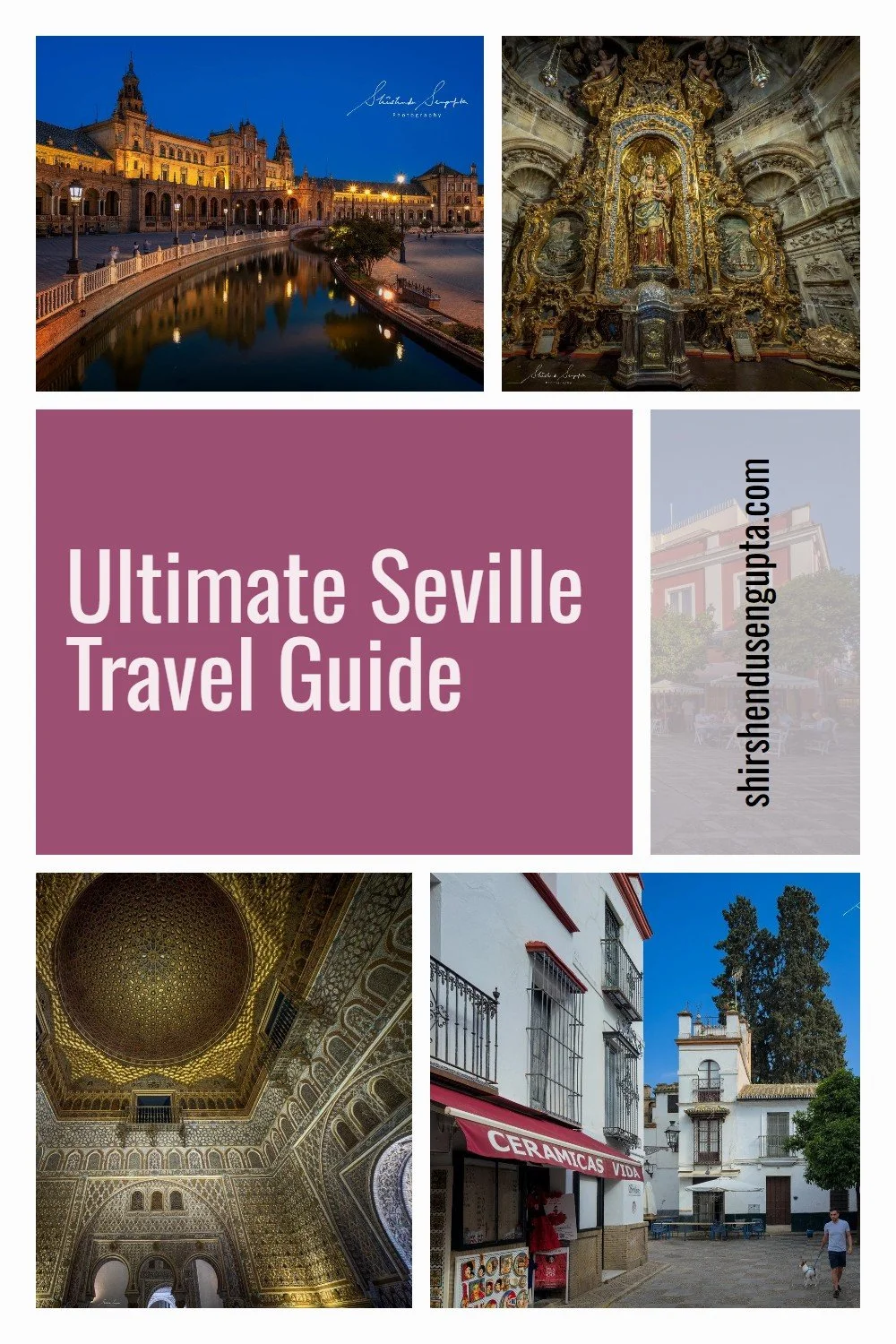
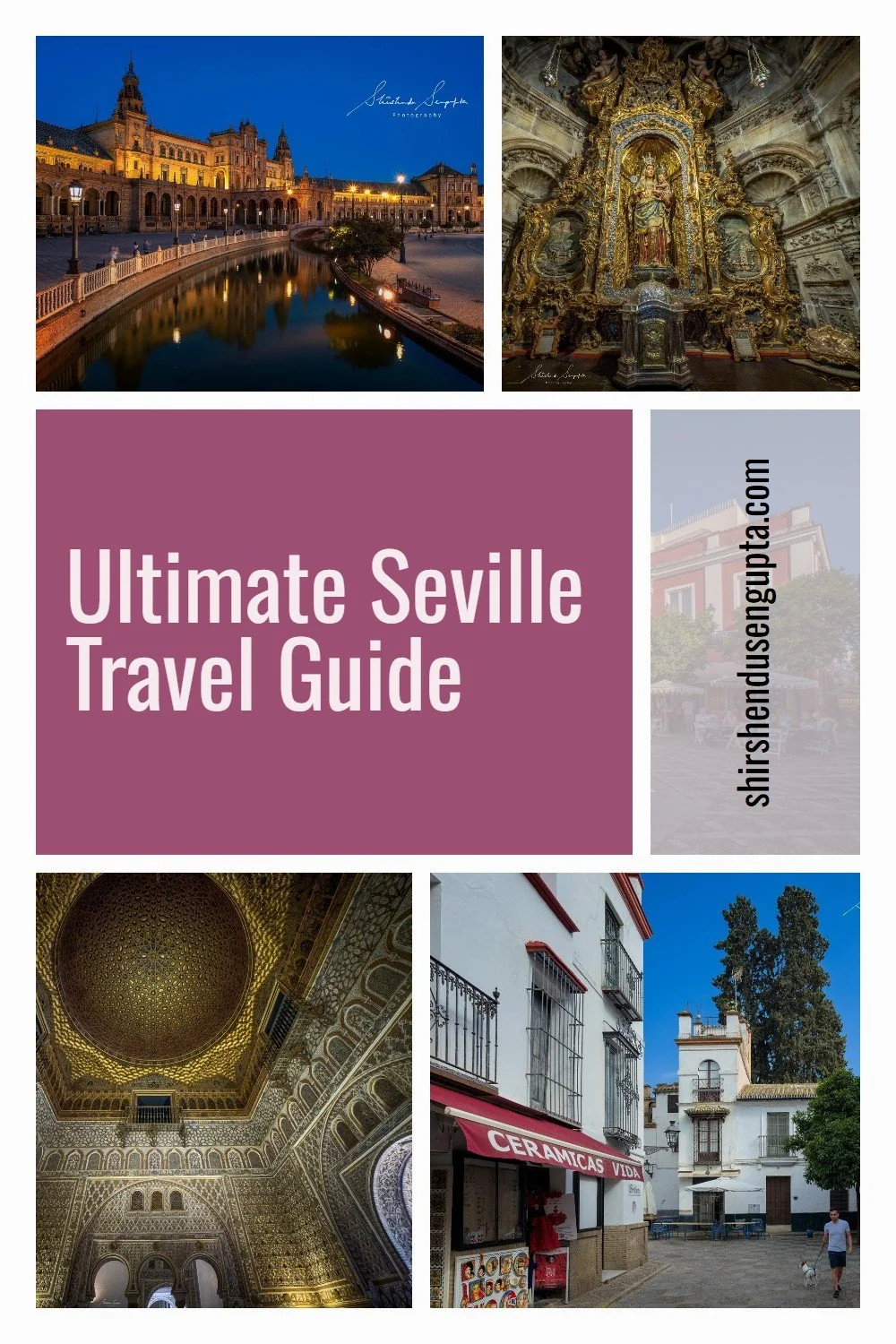
Ultimate Seville Travel Guide | Self-Guided Seville Walking Tour Itinerary | 26 Best Places to Visit, Top Things to See and Do in Seville, Spain
Prologue
During a memorable Easter, we set out on an epic adventure Where Europe Meets Africa | 7000 km Road Trip from the Netherlands to Morocco through Wine Roads, Holy Sites, and Clifftop Towns of France, Spain, and Gibraltar | Itinerary, Tips, and Tricks. What started as a casual idea soon unfolded into one of the most memorable experiences of our lifetime. Along the way, we wandered through medieval villages, sipped wine in quiet French vineyards, stood in awe at ancient cathedrals and abbeys, drove along coastal cliffs, and watched the cultures of Europe slowly melt into the soulful rhythms of Morocco.
Along the way, nestled deep in the sun-soaked heart of Andalusia, we found Seville, a city where history, passion, and artistry come together in a mesmerizing dance. Its orange-scented streets, intricate Moorish architecture, flamenco rhythms, and timeless plazas felt like stepping into a living storybook. Every corner whispered tales of empires, explorers, and poets. So, based on our experience, today I’m going to take you along with me on a ride across the 26 best things to see and do in Seville. Let the journey begin!
Welcome to Seville
Welcome to Seville (pronounced as ‘Seh-vayl’ in English) or Sevilla (pronounced as ‘Seh-bee-yah’ in Spanish), the radiant capital of the region of Andalusia, Spain, where centuries of history unfold beneath the golden Spanish sun. Founded as the Roman city of Hispalis, Seville later flourished under Moorish rule, leaving behind an enduring legacy of stunning Islamic architecture, intricate tilework, and serene courtyards. After the Christian reconquest in 1248, the city transformed into a powerful cultural and economic hub, eventually becoming the gateway to the New World during Spain’s Age of Exploration.
Walking through Seville today feels like traveling through layers of time. Gothic cathedrals rise beside Moorish palaces, while narrow medieval lanes open into lively plazas filled with music and laughter. The city is deeply rooted in tradition, from passionate flamenco performances to grand religious processions during Holy Week. Yet, it also embraces a vibrant modern spirit, with bustling cafés, contemporary art, and an unmistakable zest for life.
Seville is not just a destination; it is an experience that engages all senses. The scent of orange blossoms lingers in the air, the sound of guitar strings echoes through alleyways, and the warmth of its people leaves a lasting impression. It is a city that invites you to slow down, explore deeply, and fall in love with every moment.
26 Best Things To See and Do in Seville
Explore Barrio de Santa Cruz (Former Jewish Town)
At the heart of Seville lies Barrio de Santa Cruz, the city’s former Jewish quarter and one of its most enchanting neighborhoods. Once home to a thriving Jewish community during the medieval period, this area witnessed both cultural prosperity and eventual upheaval following the Spanish Inquisition. Today, it stands transformed into a labyrinth of narrow cobbled streets, whitewashed houses, and hidden courtyards overflowing with flowers. Most of Seville’s key attractions are concentrated within or around this historic district, making it the perfect base to begin exploring the city on foot. Follow the itinerary below to experience the very best of Barrio de Santa Cruz and its surrounding landmarks.
Royal Alcázar of Seville (Plaza del Triunfo)
Begin your day at Plaza del Triunfo, which serves as a grand historical gateway to two of Seville’s most important monuments: the Royal Alcázar of Seville and the Monumento a la Inmaculada Concepción. The square itself was named to commemorate the city’s survival after the 1755 Lisbon earthquake, symbolizing divine protection and resilience.
The Royal Alcázar is one of the oldest royal palaces still in use in Europe. Originally constructed as a Moorish fortress in the 10th century, it was later expanded by Christian monarchs, resulting in a unique architectural fusion known as Mudéjar style. Islamic geometric patterns, Gothic halls, Renaissance courtyards, and Baroque additions coexist seamlessly within its walls.
Historically, the Alcázar served as a residence for Spanish royalty, including members of the Castilian crown. Its intricate tilework, carved stucco, and serene gardens reflect centuries of craftsmanship and cultural exchange. The gardens, filled with fountains, palm trees, and exotic plants, were influenced by Islamic concepts of paradise. Today, the Royal Alcázar of Seville remains a UNESCO World Heritage Site and one of the most visited landmarks in Spain. Booking tickets in advance is essential due to high demand. A visit here offers a journey through centuries of power, artistry, and royal history.
To know more about the Royal Alcázar and how to visit it, please read our article A Walk through the Royal Alcázar of Seville | Essential Guide to Plan Your Visit to the Real Alcázar de Sevilla, Spain.
Monumento a la Inmaculada Concepción (Plaza del Triunfo)
Standing gracefully in Plaza del Triunfo, the Monumento a la Inmaculada Concepción is a striking tribute to the Virgin Mary and a symbol of deep religious devotion in Seville. Erected in the early twentieth century, the monument reflects the city’s long-standing reverence for the Immaculate Conception, a belief that holds special significance in Spanish Catholic tradition, which states that the Virgin Mary was conceived without original sin, meaning she was preserved in a state of purity from the very beginning of her life.
The monument features a central statue of the Virgin Mary, elevated on a tall pedestal and surrounded by figures representing important historical and religious personalities who defended the doctrine of the Immaculate Conception. The intricate detailing and sculptural composition create a powerful visual narrative, drawing visitors into its spiritual and historical context. The monument reflects Spain’s strong Catholic traditions, especially during the Counter-Reformation period, when Marian devotion became central to religious expression.
Its location between the Royal Alcázar of Seville and the Catedral de Sevilla places it at the symbolic heart of Seville’s spiritual landscape. The monument is not only an artistic structure but also a gathering point during religious celebrations and processions. Visitors often pause here before entering the surrounding monuments, using it as a moment of reflection. The combination of historical significance and spiritual symbolism makes it an essential part of understanding Seville’s religious heritage and its enduring cultural traditions.
Plaza del Patio de Banderas
Plaza del Patio de Banderas is one of the most historically significant open spaces in Seville, located directly adjacent to the Royal Alcázar of Seville. Its name, meaning “Courtyard of Flags,” refers to its historical role as a ceremonial and administrative space during royal and colonial times. Originally part of the Alcázar’s extended defensive complex, this courtyard served as a gathering point for military, political, and diplomatic activities. Archaeological evidence suggests that beneath its surface lie remnants of Roman structures and earlier Islamic fortifications, highlighting its long-standing strategic importance.
Today, Patio de Banderas is an open square framed by elegant historic buildings and high walls of the Alcázar. One of its most striking features is the iconic view of La Giralda, which rises dramatically above the surrounding rooftops, creating one of the most photographed perspectives in Seville. Despite its proximity to major tourist attractions, the courtyard maintains a surprisingly calm atmosphere. Orange trees and quiet corners give it a contemplative feel, allowing visitors to pause and absorb the layered history around them. It acts as a transitional space between the grandeur of the Alcázar and the intimate streets of Santa Cruz.
Catedral de Sevilla and La Giralda (Plaza Virgen de los Reyes)
Just a short walk away lies Plaza Virgen de los Reyes, a lively square that leads to the awe-inspiring Catedral de Sevilla, the largest Gothic cathedral in the world. The site originally housed a mosque during the Almohad period, reflecting Seville’s Islamic past before the Christian conquest in 1248 under Ferdinand III. After the Reconquista, the mosque was gradually replaced by a monumental cathedral built to demonstrate the city’s wealth and devotion. Construction began in the early 15th century and continued for over a century, resulting in a breathtaking Gothic masterpiece filled with chapels, altars, and artistic treasures. One of its most significant features is the tomb of Christopher Columbus, whose remains are housed here.
Adjacent to the cathedral stands La Giralda, originally built as a minaret in the 12th century and later converted into a bell tower. Its ramped interior design reflects Moorish engineering, allowing guards to ascend on horseback in earlier times. Climbing La Giralda is a memorable experience, offering panoramic views over Seville’s rooftops and beyond. The gentle ramps, instead of stairs, were designed so that guards could ride horses to the top in earlier times. Together, the cathedral and La Giralda represent Seville’s unique blend of cultures and architectural brilliance. Booking tickets in advance ensures a smooth visit, allowing you to fully immerse yourself in this historic masterpiece.
To know more about the Seville Cathedral and how to visit, please read our article Ultimate Guide to Visiting Seville Cathedral | A Virtual Tour of Seville Cathedral | 12 Interesting Things to See and Know about Catedral de Sevilla, Spain.
Tomb of Archbishop Gonzalo de Mena y Roelas, located in the Santiago Chapel within the Seville Cathedral
Tomb of Cardinal Juan de Cervantes, located in the Chapel of San Hermenegildo within the Seville Cathedral
The tomb of Christopher Columbus supported by four figures, each representing one of the historic Spanish kingdoms of his era: Castile, Aragon, Navarre, and León.
Plaza de la Alianza
Plaza de la Alianza is a small but historically rich square located within the Santa Cruz district of Seville. Its origins date back to the medieval period, when this area formed part of the city’s fortified and residential core under both Islamic and Christian rule. The square is enclosed by traditional Andalusian houses featuring whitewashed walls, wrought iron balconies, and flower-filled patios. Its intimate scale reflects the urban design of old Seville, where shaded courtyards and narrow streets helped regulate temperature and encourage social interaction.
Historically, Plaza de la Alianza is believed to have been part of the defensive and residential network near the Alcázar complex. Over time, it evolved into a peaceful neighborhood space, retaining its charm while becoming less militarized and more residential. Today, the square offers a tranquil atmosphere away from the busier tourist routes. Small cafés and quiet benches make it an ideal place to rest while exploring Santa Cruz. The gentle sound of fountains and the surrounding architectural harmony create a timeless ambiance that reflects Seville’s enduring blend of history, beauty, and everyday life.
Rodrigo Caro Street
Rodrigo Caro Street lies within the heart of the Santa Cruz district in Seville and reflects the layered medieval evolution of the old city. Named after the 17th-century Sevillian scholar and poet Rodrigo Caro, this narrow street preserves the intimate urban fabric that once defined the Jewish and later Christian quarters of Seville. Historically, this area developed over earlier Roman and Moorish foundations, resulting in an organic street pattern that prioritizes shade, ventilation, and pedestrian movement. The street is lined with whitewashed façades, wooden balconies, and discreet doorways that open into private courtyards, many of which still retain traditional Andalusian architectural elements.
Walking along Rodrigo Caro Street feels like stepping through centuries of literary and cultural memory. Its connection to Rodrigo Caro adds intellectual depth, as he was one of the early historians who documented Seville’s Roman heritage and ancient inscriptions. The street’s calm atmosphere contrasts with nearby tourist-heavy areas, making it ideal for slow exploration. Today, it connects several key points in Santa Cruz, acting as both a passageway and a destination in itself. The blend of historical continuity and everyday life gives this street its quiet charm, embodying Seville’s ability to preserve its past within a living, breathing urban landscape.
Plaza de Doña Elvira
Plaza de Doña Elvira is one of the most picturesque squares in the Santa Cruz district, surrounded by traditional Andalusian houses adorned with ceramic tiles, wrought iron balconies, and cascading bougainvillea. Its origins date back to the medieval restructuring of Seville following the Christian conquest, when many Jewish properties were repurposed into residential courtyards. The square is named after Doña Elvira de Ayala, a noblewoman connected to Seville’s aristocratic history. Over time, it became a residential and social gathering space, reflecting the evolution of urban life in historic Seville.
Architecturally, the square is a perfect example of Andalusian design principles, where shaded arcades, central fountains, and enclosed spaces create a cool microclimate. The central fountain, surrounded by tiled benches, acts as the focal point of the square and encourages quiet reflection. Plaza de Doña Elvira is also linked to literary tradition, often associated with romantic legends and the fictional world of Don Juan (more about him coming later in the article). Today, it remains a peaceful enclave where visitors can experience the slower rhythm of Seville, away from the bustling tourist routes. Its charm lies in its harmony of architecture, history, and atmosphere.
Juderia Street
Juderia Street is one of the most historically evocative streets in Seville, tracing its roots back to the city’s former Jewish quarter during the Middle Ages. The term “Juderia” itself refers to Jewish neighborhoods in medieval Spain, where communities lived, traded, and contributed significantly to cultural and intellectual life. During the period before 1492, this area was home to a thriving Jewish population, whose presence shaped Seville’s economic and scholarly development. After their expulsion under the Catholic Monarchs, the area underwent a significant transformation, yet its street layout and architectural essence remained intact.
Today, Juderia Street is a narrow, winding passage lined with whitewashed walls, flower pots, and wrought iron balconies. Its intimate scale reflects the medieval urban planning style designed for shade and social interaction. Walking here, visitors experience a sense of continuity with the past, where every corner carries echoes of history. The street also connects several key points within Santa Cruz, making it both a functional route and a cultural experience. Its preservation offers insight into Seville’s complex multicultural past, where Jewish, Islamic, and Christian influences intertwined to shape the city’s identity.
Hospital de los Venerables
Hospital de los Venerables is a stunning example of Baroque architecture located in the Santa Cruz district. It was founded in the 17th century as a residence for elderly priests associated with Seville’s cathedral, reflecting the city’s strong ecclesiastical traditions during the Counter-Reformation period. The building features an elegant central courtyard surrounded by arcaded galleries, richly decorated with marble columns, frescoes, and intricate plasterwork. The adjoining church is particularly notable for its elaborate ceiling paintings, considered masterpieces of Sevillian Baroque art.
Historically, the hospital was part of a broader network of charitable institutions in Seville, which provided care for clergy and the poor. Its construction was supported by wealthy patrons who sought to demonstrate both religious devotion and civic responsibility. Today, Hospital de los Venerables functions as a cultural center, hosting exhibitions and art displays that highlight Spanish Golden Age painting and Andalusian heritage. The building has been carefully restored, preserving its artistic and architectural integrity. Visitors are often struck by the peaceful atmosphere inside, which contrasts with the lively streets outside. It remains one of Seville’s finest examples of preserved Baroque architecture and cultural legacy.
Hostería del Laurel
Hostería del Laurel is a historic inn located in the Santa Cruz district, famously associated with the literary legend of Don Juan Tenorio. According to tradition, this was the setting for one of the most famous scenes in Spanish theatre, written by José Zorrilla in the 19th century. The building itself dates back several centuries and retains its traditional Andalusian character, with rustic interiors, wooden beams, and a charming courtyard atmosphere. It reflects the typical architecture of old Seville inns that once provided lodging and meals for travelers, merchants, and pilgrims.
Historically, such establishments played an important role in the social and economic life of the city, offering hospitality in a period when travel was slow and arduous. The Hostería del Laurel became particularly famous due to its association with the romantic and rebellious figure of Don Juan, a character deeply embedded in Spanish cultural identity. Today, the inn continues to operate, allowing visitors to experience a blend of history and gastronomy. Dining here offers a sense of stepping into a theatrical past where literature and reality intertwine. It remains a symbolic location for understanding Seville’s rich storytelling tradition.
Plaza Alfaro
Plaza Alfaro is a quiet, almost hidden square in the Santa Cruz district of Seville, often overlooked by mainstream tourist routes. It is named after the Alfaro family, historically associated with Seville’s aristocratic and intellectual circles. The square reflects the layered urban evolution of the old Jewish quarter, later transformed under Christian rule. One of its most famous associations is with the legend of Don Juan Tenorio, as literary tradition places the balcony of Doña Inés nearby. This connection ties the square to Seville’s deep theatrical and romantic mythology, which has influenced Spanish literature for centuries.
Architecturally, Plaza Alfaro is framed by elegant Andalusian houses with white façades, wooden balconies, and flower-filled patios. Its small size creates an intimate atmosphere where time seems to slow down. The central space is simple, yet it carries a strong sense of historical continuity. Unlike larger squares, Plaza Alfaro feels residential and personal, offering a glimpse into how people lived within the historic center. It is a peaceful stop where visitors can reflect on Seville’s blend of history, literature, and everyday life.
Plaza de Santa Cruz
Plaza de Santa Cruz is the symbolic heart of the Santa Cruz neighborhood in Seville. Historically, this area formed part of the city’s Jewish quarter before its transformation following the Christian reconquest. The original parish church that once stood here was destroyed in the 19th century, but the square continues to preserve its spiritual and cultural identity. Today, the square is marked by a central iron cross, surrounded by orange trees, tiled benches, and traditional Andalusian façades. It serves as a peaceful gathering place for both locals and visitors exploring the winding streets of Santa Cruz.
The atmosphere here reflects the essence of old Seville, where religion, community, and daily life were deeply interconnected. The surrounding streets retain medieval layouts, with narrow passages leading to hidden courtyards and small plazas. Plaza de Santa Cruz is also closely tied to the city’s artistic and literary traditions, often appearing in romanticized depictions of Seville. It remains a quiet yet meaningful space, offering a pause from the busier nearby landmarks such as the Alcázar and the cathedral.
Monumento a Don Juan Tenorio (Plaza de los Refinadores)
Plaza de los Refinadores is one of the most culturally significant squares in Seville due to its association with the legendary figure of Don Juan Tenorio. At its center stands a statue of Don Juan, one of Spain’s most famous fictional characters, created by playwright José Zorrilla in the 19th century, although earlier versions of the character date back to Tirso de Molina in the 17th century. Don Jaun was portrayed as a charismatic nobleman known for his charm, reckless behavior, and endless romantic pursuits. His story blends romance, morality, and redemption, making him not just a symbol of seduction but also an enduring part of Spanish literature and cultural folklore.
Historically, the square is located within the Santa Cruz district, an area already rich in medieval and Renaissance history. Its naming as “Refinadores” refers to nearby workshops that once processed metals, reflecting the city’s artisanal past. Today, the square is a cultural landmark where visitors encounter both history and literature intertwined. The statue of Don Juan serves as a reminder of Seville’s powerful role in shaping Spanish storytelling traditions. It is a place where myth and reality merge within the urban landscape.
Plaza de las Cruces
Plaza de las Cruces is one of the quieter yet historically layered corners of the Santa Cruz district in Seville. The square is named after the crosses that traditionally mark its central point, a reminder of the Christian transformation of what was once part of the old Jewish quarter. During medieval times, this area formed part of a dense residential network where narrow streets and small plazas were designed to create shade and privacy in the Andalusian climate. After the Christian reconquest, many of these spaces were reinterpreted and renamed, and Plaza de las Cruces became a symbolic representation of religious transition and urban continuity.
Today, the square is intimate and peaceful, surrounded by whitewashed façades, flowering balconies, and quiet residential buildings. Unlike the more famous plazas nearby, it retains a local character, often overlooked by tourists moving between major landmarks. Its simplicity is what makes it powerful. There are no grand monuments here, only the subtle rhythm of daily life in historic Seville. The square acts as a breathing space within Santa Cruz, where the layers of Jewish, Islamic, and Christian history quietly coexist in the architecture and street layout.
Iglesia de Santa María la Blanca
Iglesia de Santa María la Blanca is one of the most fascinating examples of Seville’s layered religious history. Originally built on the site of a synagogue, its origins trace back to the medieval Jewish community that once flourished in this part of Santa Cruz. After the expulsion of the Jews in 1492, the building was converted into a church, reflecting the sweeping religious transformation of the city. The church has undergone multiple reconstructions, most notably in the 17th century when it was redesigned in a stunning Baroque style. Inside, visitors are greeted by elaborate stucco work, gilded altarpieces, and soft lighting that creates a deeply atmospheric interior. Despite its Christian identity today, subtle architectural traces of its Jewish past remain embedded in its structure.
Historically, this site represents Seville’s complex narrative of coexistence, transition, and cultural layering. Few buildings in the city embody such a direct transformation from synagogue to church, making it a powerful symbol of historical change. Today, it is admired not only for its religious function but also for its artistic beauty. The interior feels intimate and richly decorated, offering a contrast to the monumental scale of Seville’s cathedral. It is a hidden gem that reveals the city’s multicultural past.
Santa Cruz Church
Iglesia de Santa Cruz once stood as the parish church of the Santa Cruz district, a spiritual anchor for the former Jewish quarter that was transformed after the Reconquista. The original structure was destroyed in the 19th century during urban redevelopment, but its historical presence continues to shape the identity of the surrounding square. The church was originally established to serve the converted Jewish population who remained in the area after 1492. It symbolized the religious restructuring of Seville, where former synagogues and community spaces were repurposed into Christian institutions.
Although the physical building no longer exists in its original form, the site retains symbolic importance. The central cross in Plaza de Santa Cruz marks its former location, preserving its memory within the urban landscape. Today, visitors encounter the site as part of the broader Santa Cruz experience, where history is embedded in street names, spatial layout, and architectural fragments rather than a single monument. This absence is itself meaningful, reflecting how Seville’s history is layered, sometimes preserved through transformation rather than preservation. The Santa Cruz Church remains a quiet reminder of the city’s complex religious and cultural evolution.
Teresa Street and Casa de Murillo
Calle Santa Teresa and the nearby Casa de Murillo form one of the most culturally rich corners of Santa Cruz. Calle Santa Teresa is a narrow, atmospheric street named after Saint Teresa of Ávila, reflecting Seville’s deep connection to Catholic mysticism and spiritual tradition. The street is lined with traditional Andalusian homes, whitewashed walls, and quiet patios, offering a calm escape from busier tourist routes. It retains the intimate scale of medieval Seville, where pedestrian movement shaped urban design long before modern planning.
At the end of this street lies Casa de Murillo, the former residence of the celebrated Baroque painter Bartolomé Esteban Murillo. Murillo lived in Seville during the 17th century, a period often considered the city’s artistic golden age. His paintings, known for their soft religious imagery and emotional warmth, reflect the spiritual atmosphere of Counter-Reformation Seville. Today, Casa de Murillo functions as a small cultural space and memorial, preserving the artist’s legacy. Though modest in size, it carries significant artistic importance, linking Seville’s streets directly to its artistic heritage. Together, the street and house offer a quiet but meaningful journey into Seville’s spiritual and artistic history.
Calle Mateos Gago
Calle Mateos Gago is one of the most vibrant streets in Seville, connecting the Santa Cruz district to the iconic Catedral de Sevilla. Named after the 19th-century Sevillian scholar Mateos Gago, the street reflects both intellectual heritage and modern urban life. Historically, this route has served as an important passage between religious, commercial, and residential areas of the old city. Over time, it evolved into a lively thoroughfare filled with cafés, tapas bars, and traditional Andalusian architecture.
The street is especially known for its proximity to the cathedral’s Giralda tower, which dominates the skyline at its end. This creates a dramatic visual corridor that blends daily life with monumental architecture. Today, Calle Mateos Gago is one of the best places in Seville to experience local gastronomy and street atmosphere. Outdoor terraces are filled with locals and visitors enjoying tapas and conversation, while the historic buildings around them preserve centuries of architectural evolution. It represents the living pulse of Seville, where history is not confined to monuments but continues in everyday life.
Fuente Farola
Fuente Farola is a distinctive landmark located within the Santa Cruz area, combining both functional and decorative elements. The structure serves as both a fountain and a lamp post, reflecting 19th-century urban design trends in Seville when public spaces were being modernized with ornamental infrastructure. Architecturally, Fuente Farola is modest yet elegant, featuring ironwork, stone detailing, and traditional Sevillian design elements. Its presence adds charm to the surrounding streets, enhancing the atmospheric quality of the neighborhood.
Historically, such fountains played an important role in providing water to residents before modern plumbing systems were introduced. At the same time, the integration of lighting reflects the city’s gradual transition into a more contemporary urban environment. Today, it stands as a small but meaningful piece of Seville’s urban heritage. While not as grand as nearby monuments, it contributes to the character of Santa Cruz by preserving the aesthetic continuity of the historic center. Visitors often pass by it without realizing its historical significance, yet it quietly reflects Seville’s evolution from medieval city to modern cultural capital.
Monumento a Juan Pablo II
Monumento a Juan Pablo II is a modern religious monument dedicated to Pope John Paul II, reflecting his significant influence on the Catholic world and his visits to Spain. Located near Fuente Farola, it represents the continued importance of the Catholic faith in the city’s identity. The monument depicts the Pope in a blessing gesture, symbolizing peace, compassion, and spiritual leadership. It was erected to honor his contributions to global dialogue and his role in strengthening the modern Catholic Church.
Although relatively recent compared to Seville’s ancient landmarks, the monument fits within the city’s long tradition of religious art and public devotion. It connects contemporary faith expressions with centuries-old spiritual heritage found throughout Seville. Historically, Seville has been one of Spain’s most important religious centers, and monuments like this continue that legacy into the present day. It is often visited by pilgrims and locals who wish to pay respects or reflect on the Pope’s message. The monument serves as a reminder that Seville’s identity is not only rooted in its medieval and Renaissance past but also in its ongoing spiritual and cultural evolution.
Palacio Arzobispal de Sevilla
Palacio Arzobispal de Sevilla is an impressive Baroque palace located adjacent to the cathedral in the heart of Seville. It serves as the official residence of the Archbishop of Seville and has played an important role in the city’s religious administration for centuries. Historically, the palace was built on land that once belonged to earlier ecclesiastical structures, reflecting the continuity of religious authority in this area. Its current Baroque design dates mainly from the 18th century, showcasing ornate façades, grand courtyards, and richly decorated interiors.
The building stands as a symbol of the Catholic Church’s enduring influence in Seville, particularly after the Reconquista, when the city became a major center of ecclesiastical power in Spain. While the interior is not always open to the public, the exterior alone is striking, with elaborate stonework and a monumental presence that complements the nearby cathedral complex. Its architectural harmony with surrounding historic buildings contributes to the unified aesthetic of the cathedral square. The palace remains an important institution in Seville’s religious life and a key part of the city’s architectural heritage.
Stepping Beyond Santa Cruz – Plaza de Toros Maestranza de Seville
As we step outside Barrio de Santa Cruz, the journey through Seville continues toward some of its other iconic landmarks, beginning with the historic Plaza de Toros de la Maestranza. One of the oldest and most prestigious bullrings in Spain, it holds a deep connection to the cultural tradition of bullfighting in Andalusia. Construction began in the 18th century, and over time, it evolved into a powerful symbol of Spanish heritage and identity. The bullring is renowned for its distinctive oval shape, elegant Baroque façade, and intricately arranged seating galleries. It has witnessed countless historic bullfights, featuring some of Spain’s most celebrated matadors. These events are especially significant during festivals such as Feria de Abril, when the city comes alive with tradition and spectacle.
Historically, bullfighting developed from medieval jousting and aristocratic displays of skill before becoming a formalized public performance. Today, the Maestranza also houses a museum that explores the history, costumes, and rituals associated with the tradition. Even for those who choose not to attend a bullfight, the site’s architectural beauty and cultural significance make it an essential stop, representing a complex and deeply rooted aspect of Seville’s heritage.
Final Stop – Plaza de España
Now we head a bit farther out to conclude our walking route through Seville with one of its most magical locations, the breathtaking Plaza de España. A visit here feels nothing short of cinematic, offering one of the most remarkable architectural experiences in all of Spain. Built for the Ibero-American Exposition of 1929, it was designed by architect Aníbal González to symbolize Spain’s relationship with its former colonies. Historically, the exposition aimed to strengthen cultural and economic ties between Spain and Latin America. The plaza was intended as a monumental statement of unity, progress, and artistic excellence.
Its grand semi-circular structure, symbolizing Spain’s embrace of its former territories, creates a sense of openness and harmony. Along its walls, vibrant ceramic tiles represent each province of Spain, telling stories through detailed and colorful artwork. The semi-circular structure combines Renaissance Revival and Moorish Revival styles, reflecting Seville’s diverse architectural heritage. A canal runs gracefully along the façade, where visitors can rent small boats and glide beneath elegant bridges, adding a sense of calm to the grandeur.
Today, Plaza de España stands as one of the most visited landmarks in Seville, admired not only for its architectural brilliance but also for its presence in several international films, which has enhanced its global recognition. Surrounded by lush gardens and wide promenades, the plaza invites slow and immersive exploration. Horse-drawn carriages pass by, musicians fill the air with gentle melodies, and occasionally a flamenco performance brings the space vividly to life. Whether capturing photographs, enjoying a quiet moment by the water, or simply absorbing the grandeur of its sweeping design, Plaza de España offers a fitting and unforgettable finale to the journey.
Visiting Seville
Best Time to Visit: The best time to visit Seville is during spring, particularly from March to May, when the weather is pleasantly warm, and the city comes alive with festivals. Events like Semana Santa and Feria de Abril showcase Seville’s vibrant traditions, offering a unique cultural experience. Autumn, from September to November, is another excellent time, with fewer crowds and comfortable temperatures. Summers can be extremely hot, often exceeding forty degrees Celsius, making sightseeing challenging. Winter remains mild and quieter, ideal for those who prefer a more relaxed pace while still enjoying the city’s rich history and charm. We visited Seville during Easter in late April.
Number of Days to Stay: To truly experience Seville, a stay of three to four days is ideal. This allows enough time to explore major landmarks such as the Alcázar, the cathedral, and the historic neighborhoods without feeling rushed. It also provides opportunities to enjoy local experiences like flamenco shows, tapas tastings, and leisurely walks along the Guadalquivir River. Travelers with a deeper interest in history and culture may consider extending their stay to five days, allowing for day trips to nearby destinations. A well-paced itinerary ensures you can absorb the essence of Seville while still leaving room for spontaneous discoveries.
Best Place to Stay: For first-time visitors, staying in or near Barrio de Santa Cruz is highly recommended. This historic neighborhood places you within walking distance of major attractions, allowing you to fully immerse yourself in Seville’s charm. The area offers a range of accommodations, from boutique hotels to traditional guesthouses, many set within beautifully restored buildings. Alternatively, the El Arenal district provides easy access to the river and a lively atmosphere with plenty of dining options. Choosing a central location enhances your experience, making it convenient to explore the city both during the day and at night. We stayed in an apartment near Plaza Alfaro.
Best Way to Arrive: The most convenient way to reach Seville is by air, with Seville Airport serving both domestic and international flights. From the airport, buses, taxis, and private transfers provide easy access to the city center. Travelers already within Spain can opt for high-speed trains, with the AVE network connecting Seville to major cities like Madrid and Barcelona efficiently. Driving is also an option, especially for those on a road trip through Andalusia, though parking in the historic center can be limited. Choosing the right mode depends on your itinerary and travel preferences. We drove to Seville from the Netherlands by car.
Best Local Mode of Conveyance: Exploring Seville is best done on foot, especially within the historic center, where many attractions are closely located. Walking allows you to fully appreciate the city’s intricate architecture, hidden courtyards, and vibrant street life. For longer distances, the public transport system, including buses and trams, is efficient and affordable. Bicycles are also popular, with dedicated lanes making cycling a pleasant option. Taxis and ride-hailing services are readily available for convenience. Combining walking with occasional public transport ensures a comfortable and immersive way to navigate Seville.
Epilogue
Seville is a city that lingers in your memory long after you leave, with its vibrant culture, layered history, and timeless beauty. From grand palaces and towering cathedrals to quiet alleys and lively plazas, every moment here feels like a story waiting to be told. It is destinations like these that transform journeys into lifelong memories. Please let us know in the comments below if you enjoyed reading this article. And until we meet next time, I wish you merry traveling and happy shooting!
And if you want to read the day-by-day account of our 7000 km road run from the Netherlands to Morocco during Easter, please visit our article Where Europe Meets Africa | 7000 km Road Trip from the Netherlands to Morocco through Wine Roads, Holy Sites, and Clifftop Towns of France, Spain, and Gibraltar | Itinerary, Tips, and Tricks. Until then, merry traveling and happy shooting!
Pin the article
Bookmark the article for reading later!
Want to license/buy photos in the article?
License photos for commercial/editorial use or buy photo prints!
Want us to write an article for you?
Articles for magazines, newspapers, and websites!
Watch our Videos
Check out our videos on our Youtube Channel!
Join the Newsletter
Get updates on our latest articles!
We respect your privacy. Read our policy here.







Prague, the enchanting capital of Czechia, is a city where medieval streets, Gothic cathedrals, Baroque palaces, and riverside panoramas come together in a single unforgettable travel experience. Set along the banks of the Vltava River, it has captivated travelers for centuries with its fairy tale skyline and rich cultural atmosphere. Known as “The City of a Hundred Spires,” Prague blends history, architecture, music, literature, and everyday local life in a way few European cities can match.