
Visiting the Largest Underground Church in Europe - Monolithic Church of Saint-Émilion, France
Prologue
During a memorable Easter, we set out on an epic adventure Where Europe Meets Africa | 7000 km Road Trip from the Netherlands to Morocco through Wine Roads, Holy Sites, and Clifftop Towns of France, Spain, and Gibraltar | Itinerary, Tips, and Tricks. What started as a casual idea soon unfolded into one of the most memorable experiences of our lifetime. Along the way, we wandered through medieval villages, sipped wine in quiet French vineyards, stood in awe at ancient cathedrals and abbeys, drove along coastal cliffs, and watched the cultures of Europe slowly melt into the soulful rhythms of Morocco.
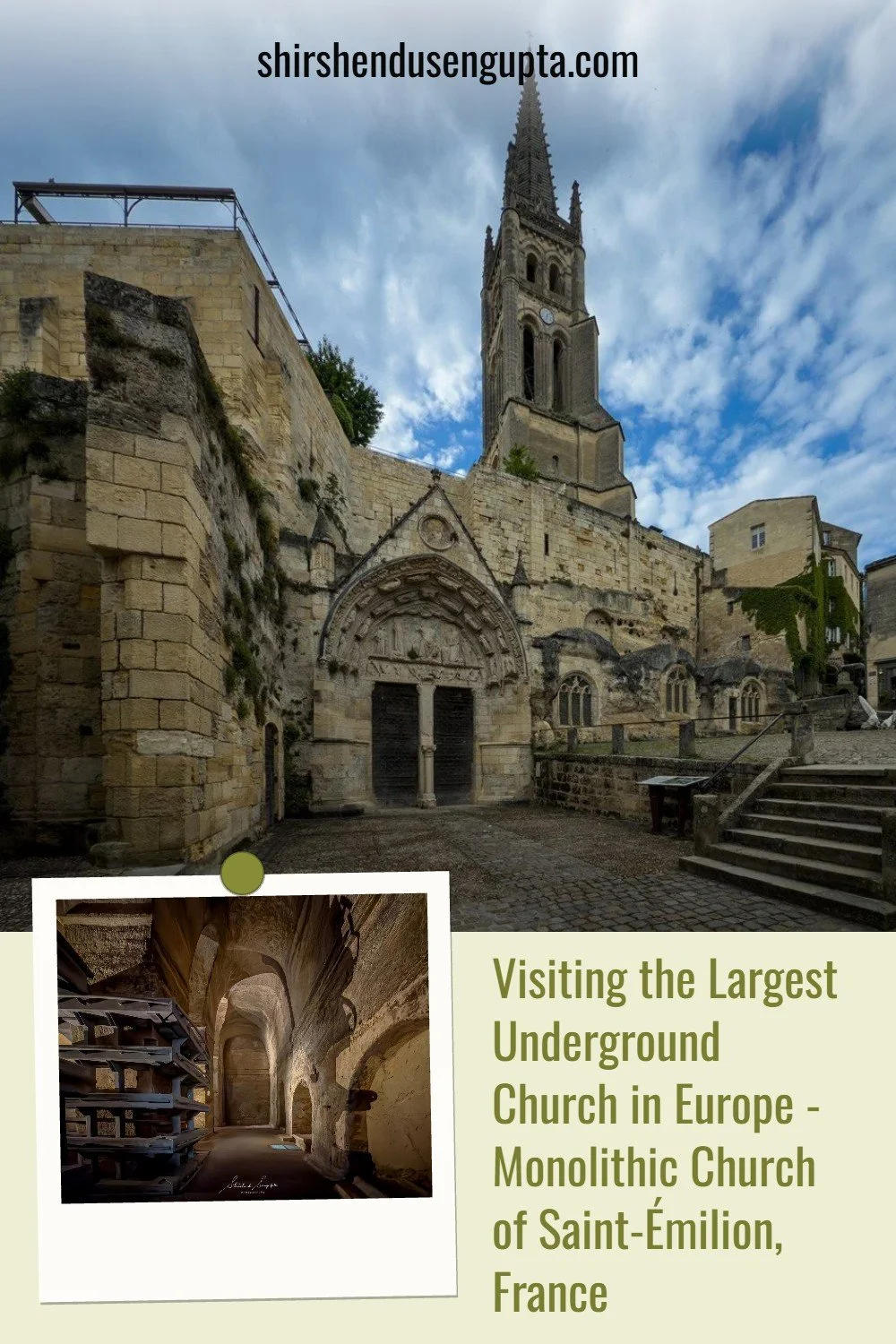
Amid this incredible journey, our first stop was the UNESCO World Heritage village of Saint-Émilion, a place where history, faith, and viticulture intertwine. Nestled atop a limestone plateau, the village is famed for its centuries-old vineyards, cobbled streets, and monumental underground church carved from solid rock. Today, I invite you to join me as we explore everything you need to know before visiting the extraordinary Monolithic Church of Saint-Émilion, from its legendary origins to its intricate subterranean architecture, artistic features, and enduring spiritual significance. Let the history and devotion of this remarkable site unfold!
Welcome to Saint-Émilion
Saint-Émilion is an enchanting medieval village situated in the heart of the Bordeaux wine region, where limestone houses, narrow cobblestone lanes, and terraced vineyards form a picture-perfect landscape. Human presence in Saint-Émilion dates back to prehistoric times, at the heart of the Ascumbas forest. The former name of the region, ‘Ascumbas,’ derives from the Gascon word ‘cumbas,’ meaning ‘combes,’ or natural basins formed by erosion. Around 30 million years ago, the ocean that once covered this territory gave way to a vast limestone plateau. Stone extraction from the Middle Ages through the 19th century significantly contributed to the economic development of the village and its surroundings. Vineyards were supposedly established during Antiquity, between the 2nd and 4th centuries, often near agricultural villas, laying the foundation for a centuries-old winemaking tradition.
The village owes its name to Émilion, a monk from Brittany who arrived in the area during the 8th century. Seeking solitude, he lived as a hermit inside a natural cave carved into the limestone cliffs, where he is said to have performed numerous miracles, including healing the sick and blessing vineyards for abundant harvests. His piety attracted followers who settled around him, forming a community that eventually evolved into a spiritual center. After his death, pilgrims visited the site to honor his memory, and the settlement eventually became known as Saint-Émilion in tribute to the monk who shaped its early life. The wine-making culture began to flourish here during the Middle Ages, supported by the unique limestone soil that gives Saint-Émilion wines their distinctive character. Over the centuries, the village expanded with cloisters, churches, fortifications, and noble houses. The monolithic church (largest underground church in Europe), carved directly above the saint’s original hermitage, preserves the saint’s relics, making the village an important stop on the route to Santiago de Compostela (the final destination of the Camino de Santiago, or “Way of St. James,” a major Christian pilgrimage route that has been followed since the Middle Ages). The village was also home to several religious communities until the French Revolution in the 18th century. Today, Saint-Émilion is recognized as a UNESCO World Heritage Site because of its continuous wine-making history and exceptionally preserved medieval architecture.
The Story of the Monolithic Church of Saint-Émilion
By the 12th century, the village of Saint-Émilion had grown into a significant pilgrimage site, attracting both religious devotees and wealthy patrons. With increasing traffic, the community recognized the need for a grander place of worship that could accommodate pilgrims and serve as a spiritual centerpiece for the village. The limestone cliffs that had once provided shelter for Émilion were now viewed as a material canvas. Skilled masons and laborers were commissioned to carve a full church directly from the rock above the saint’s original hermitage, using just chisels and hammers, thereby creating a monolithic sanctuary that combined functionality with sacred architecture. This was a feat of immense planning and precision, as every chiseled surface had to account for structural stability, spatial proportions, and religious symbolism, all while remaining anchored in a single, unbroken mass of stone. The term ‘monolith’ comes from the Greek mono lithos, meaning ‘a single stone,’ reflecting that this church was carved entirely out of limestone in the early 12th century.
Pilgrimage activity reached its peak during the Middle Ages, when the village became a major stop on regional pilgrimage routes. Pilgrims would arrive on foot or by horseback, bring donations, pray in the dimly lit interior, and meditate near the hermit’s original cave. The monolithic design of the church allowed it to accommodate large numbers of pilgrims while also protecting them from harsh weather, seasonal floods, and potential attacks, allowing the monks to maintain uninterrupted religious practice. Monks and clerics managed the influx, offering guidance, maintaining records, and providing food and shelter in nearby accommodations. The surrounding vineyards, cultivated by monastic communities, supported this activity. This blending of spiritual and practical life strengthened the village’s economy while enriching its cultural and religious significance, making the church both a sacred and social center.
Even after the decline of monastic dominance in the 17th century, the traditions associated with pilgrimage continued. Local residents preserved the stories of Saint-Émilion and maintained the church as a living monument to faith and devotion. Seasonal festivals celebrated the saint’s life and the village’s viticultural heritage, often bringing together pilgrims, tourists, and locals in shared ceremonies. These traditions helped the church maintain relevance in a rapidly changing world, providing continuity between past and present. Today, visitors can still sense the layered history, from the saint’s hermitage to the carved monolithic nave, experiencing the convergence of legend, religion, and human artistry that defines Saint-Émilion as a cultural and spiritual treasure.
Architectural Features of the Monolithic Church
Monolithic Church Square
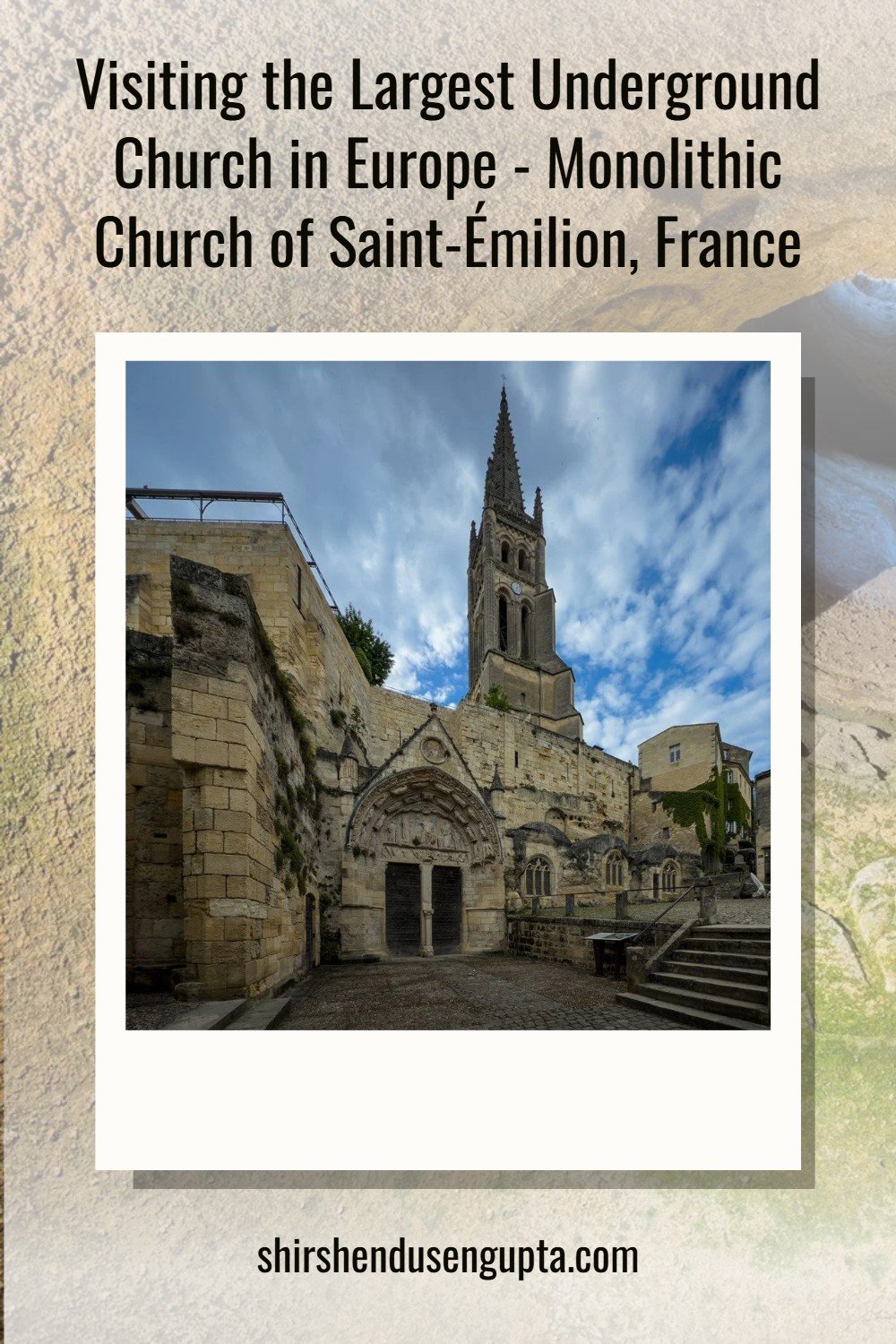
Until the 11th century, the limestone plateau extended further into what is now the square, and funeral galleries were carved into the rock. Most disappeared due to cliff collapses or limestone extraction during the 12th century, leaving a small section that forms the present-day catacombs. Situated in the hollow of the combe, Monolithic Church Square became the historical and religious heart of the village, dominated by the façade and bell tower of the monolithic church.
Bell Tower
The bell tower, built simultaneously and modified through the 17th century, rises 68 meters and served as a landmark for travellers while symbolising strong religious authority. Historically, it housed bells used to call monks, pilgrims, and villagers to prayer, marking the rhythms of daily life and religious observance. Today, visitors can access the top with a key from the Tourist Office for a very nominal charge, with free admission for children under six.
View from the bell tower of the Monolithic Church
Saint-Emilion’s Hermitage
Émilion is believed to have belonged to a lineage of Celtic hermits renowned for their piety and miraculous deeds. According to the 12th-century text Vita Saint Emilionis, Émilion (or Aemilianus), originally from Brittany, was the intendant of the Count of Vannes. His first miracle of turning stolen bread into wood as an act of generosity prompted him to flee southward to avoid his burgeoning popularity. For some time, he stayed in a Benedictine Monastery where he became a monk. Fleeing his fame once again, he eventually arrived at Ascumbas, taking refuge in a cave from 750 to 767, where he lived as a hermit. Over time, disciples joined him, forming a religious community that laid the foundation for the village. His legend and relics attracted many pilgrims traveling to Santiago de Compostela, contributing to Saint-Émilion’s economic and cultural development.
The original cave entrance, located to the right of the altar, was closed in the 18th century and replaced by a staircase with railings. Here you can find
A basin fed by a natural spring, believed to have healing properties. Émilion is said to have cured a blind woman thanks to the water.
A niche symbolizing the monk’s bed. There’s a possibility that this was actually a former burial niche.
A seat carved in stone, which used to be Saint-Émilion’s meditation seat, now known as the ‘fertility seat,’ where women seeking to conceive are said to have their wishes fulfilled. The Tourist Office regularly receives birth announcements.
Above the altar, a statue with the engraving “Saint-Émilion,” initially representing Saint Francis of Assisi, but was modified in 1946.
The Trinity Chapel
Apart from its nave, rebuilt in 1730, this chapel dates back to the early 13th century, a time of transition between the Romanesque and Gothic architectural styles in southwestern France. The choir’s base remains Romanesque, visible in the rounded-arch niches, while the nave showcases Gothic design, distinguished by its rare 8-branched ribbed vault.
The paintings on the upper choir are exceptionally well preserved. After the French Revolution, when the church’s property was confiscated, the chapel was repurposed as a grocery store and later as a cooperage during the 19th century. The smoke from heating wood during barrel-making gradually coated the walls in soot, inadvertently preserving the artwork. A restoration completed in 1997 brought the paintings back to prominence.
From left to right, the imagery includes a bishop ordaining a richly dressed figure kneeling in prayer, protected by an angel; Saint John the Baptist holding the Paschal Lamb; Christ in Majesty surrounded by the four evangelists in their symbolic representations (Matthew as an angel, John as an eagle, Mark as a lion, and Luke as a bull) with a face of God the Father below; the Madonna with Child; and the Crucifixion of Jesus Christ, flanked by the Virgin Mary and Saint John depicted in eclipse form. The lower register shows hybrid creatures with human heads and animal bodies, likely symbolising evil and human vices overcome by divine authority.
Today, the nave contains several artifacts uncovered during archaeological excavations, including sarcophagus lids, a carved stone sarcophagus, and a quarter bushel, a medieval unit for measuring grain.
The Catacombs - Gallery of the Cupola
The term ‘catacombs’ derives from the Greek kata, meaning ‘underneath,’ the Latin tumba, meaning ‘tomb,’ and cumbere, meaning ‘lying down.’ It refers to an 11th-century underground cemetery that became a significant site for pilgrims. The present catacombs consist of several separate funerary galleries, interconnected as needed over time. They were managed by a religious community supported by the Viscounts of Castillon. One notable lord, Pierre de Castillon, who participated in the First Crusade (1096–1099), reportedly traveled through central modern-day Turkey, where the underground monuments of Cappadocia may have influenced local designs.
During the 12th-century excavation of the monolithic church, this gallery was enhanced with a cupola supported by six columns, evoking the Holy Sepulchre in Jerusalem. Some sculptures are interpreted as representing the Old Testament story of ‘the three Hebrews in the furnace,’ symbolising resurrection. The three carved figures, arms extended in prayer, appear to rise from their graves toward the heavens. A central well once served as a light shaft, while circular openings on the sides illuminated a spiral staircase carved into the stone, symbolically guiding the souls of the deceased. The staircase base no longer exists. This structure may have functioned as an internal lantern for the dead, or possibly as an access to a memorial monument with relics at its center, similar to the monolithic church of Aubeterre-sur-Dronne, located 60 km north, also commissioned by the Viscounts of Castillon.
The Catacombs - Second Gallery
The second gallery contains numerous funerary niches dating to the 11th and 12th centuries. The south side includes walled-off sections and two sculpted monolithic pillars, hinting at additional underground spaces that may have existed before the 12th-century collapse of the limestone plateau. Recent archaeological research indicates that this area may have hosted worship or monastic activities before the monolithic church was built.
This gallery opens onto a hollowed space once used as a cave dwelling. In the 19th century, it served as a quarry, a small segment of the 70 hectares of underground quarries beneath the village and vineyards. Up until the 19th century, limestone from these quarries was used in construction across Saint-Émilion and nearby areas such as Libourne and parts of Bordeaux. Once quarrying was banned for safety reasons, these underground spaces were sometimes converted for mushroom cultivation or as cave dwellings known as clottes. Today, many are used as wine cellars, benefiting from ideal conditions: no natural light, constant temperature, high humidity, and absence of vibrations.
The Monolithic Church
The construction of the Monolithic Church of Saint-Émilion is a marvel of medieval engineering. Carved entirely from a single block of limestone, the church demonstrates both the ingenuity and patience of the masons who labored over it for decades. The primary technique involved careful chiseling of the rock face, starting from the top of the cliff and progressing downward to create ceilings, columns, and walls simultaneously. This method allowed the structure to maintain stability while avoiding collapse. The masons also employed a system of scaffolding and pulley mechanisms, enabling workers to transport stone debris and tools safely within the narrow confines of the underground space. The alignment of arches, pillars, and walkways required precise measurement and deep knowledge of geometry, ensuring that the final result was both functional and visually harmonious. Each element was carefully proportioned to reflect Romanesque principles, creating a balance between verticality, mass, and spatial rhythm that evokes reverence and awe. Archaeologists believe the work was completed relatively quickly, within a few decades. Measuring 38 meters long, 20 meters wide, and about 12 meters high under the vault, it is regarded as the largest underground medieval church in Europe. After disputes, the Viscounts of Castillon handed over the sanctuary to the Archbishops of Bordeaux, who entrusted Canons Regular with its care and management. The church was excavated rather than built due to Middle Eastern influences, cost and time efficiency, and the local tradition of underground monuments in Saint-Émilion.
The central vault contains a shaft marking the location of the bell tower, allowing the bell ropes to pass through. The bell tower, weighing roughly 4,500 tons, caused cracks to appear in the vault over time. To prevent collapse, the church was closed in 1990 for 15 months while 38 concrete columns were installed. Later archaeological studies revealed that underground water had weakened the limestone. Excavations uncovered a 12th-century drainage system designed to channel water outside. Over the centuries, the drains became blocked, but between 2000 and 2001, some were cleared, and the concrete columns were replaced with metal supports to maintain the weight of the bell tower.
In the Middle Ages, the church appeared very different. The walls were adorned with wood paneling and polychrome paintings, most of which have now vanished due to the limestone’s humidity. After the French Revolution, the church was abandoned, and saltpetre (a key ingredient in gunpowder) formed on the walls and was harvested over time. Some traces of polychromy survive, including a crucifixion scene on one of the pillars and decorative elements in various locations.
The central vault features two four-winged angels, or Cherubim, representing guardians of the Ark of the Covenant and God’s domain, sculpted to protect Saint Émilion’s relics, which were lost during the 16th-century Wars of Religion (36-year war in France from 1562 to 1598 between Catholics and Protestants). Near the angels, atop the central pillars, are two bas-reliefs: a centaur shooting an arrow, and two leaning beasts facing each other with entwined tails, possibly symbolising zodiac signs or evil. Another bas-relief on the north-west wall shows a dragon attacking a spear-wielding figure and a musician, likely crowned, playing a stringed instrument, an allegory of the struggle between good and evil. These unfinished works suggest the canons prioritized their new monastery in the upper town, the collegiate church, and its conventual buildings, constructed from 1140 onward. The monolithic church served as the parish church until 1791, was abandoned, and was later reconsecrated in 1838.
Originally, the altar faced northwest, an unusual orientation for a western church, as most choirs face east toward the rising sun, symbolising Christ. In the 16th century, the clergy relocated the choir to the northeast by carving new spaces. Visitors can see altars dating from the 16th to the 19th centuries, including an 18th-century altar dedicated to Saint Nicolas, likely replacing an earlier one.
Today, the monolithic church hosts occasional religious ceremonies and cultural events. It is a key monument of the Grand Saint-Émilionnais, a region of 22 municipalities. This territory corresponds to the former ‘Juridiction of Saint-Émilion,’ established in the 12th and 13th centuries by the Kings of England, later Dukes of Aquitaine. In 1936, the historic area of eight villages was chosen to define the boundaries of the Saint-Émilion wine appellation (Appellation d’Origine Contrôlée). The combination of its rich heritage and renowned vineyards also led to the former Jurisdiction being designated a UNESCO World Heritage ‘cultural landscape’ in 1999.
Visiting the Monolithic Church of Saint-Émilion
Opening Hours: The Monolithic Church of Saint-Émilion is typically open daily, with hours varying seasonally. In the spring and summer months, the church welcomes visitors from 10:00 to 18:30, while winter hours are usually shorter, from 10:00 to 17:00. It is advisable to check for temporary closures due to maintenance, religious ceremonies, or special events. Guided tours are scheduled at specific times, and entry may be limited to manage visitor flow. Arriving early ensures a quieter experience, allowing ample time to appreciate the monolithic interior, sculptures, and passages without the crowds that often gather later in the day.
Address: The Monolithic Church is located in the heart of Saint-Émilion village, an easy walk from the central square and surrounding vineyards. The official address is Place de l’Église Monolithe, 33330 Saint-Émilion, France. Its central location makes it accessible from most points within the village, allowing visitors to combine the church visit with a stroll through cobbled streets, nearby shops, and historic landmarks. Walking directions are available from the main parking areas and train stations. The church is clearly marked, and signage throughout the village ensures visitors can locate it without difficulty, enhancing the overall experience of this UNESCO World Heritage site.
GPS Coordinates: For GPS navigation, the Monolithic Church of Saint-Émilion is located at approximately 44.8934, -0.1563. Entering these coordinates into a GPS device or smartphone ensures precise navigation, whether driving from Bordeaux, walking within the village, or planning a cycling route. GPS guidance can also assist visitors using nearby parking lots or planning connections with public transport options. The coordinates point directly to the main entrance, making it easier to integrate the visit into a larger itinerary of Saint-Émilion, including vineyards, historical buildings, and panoramic viewpoints overlooking the surrounding Bordeaux countryside.
Parking: Several parking options are available for visitors arriving by car. The nearest public lot, Parking du Monolithe, is within a five-minute walk of the church entrance, providing convenience and safety for vehicles. Additional parking is available in central village lots, although spaces may fill quickly during peak tourist seasons. Many visitors opt for free street parking slightly outside the main village area, combining a short walk with sightseeing. It is recommended to arrive early or late in the afternoon to secure a spot during busy periods. Accessible parking for visitors with reduced mobility is also available near the main entrance. We parked in the Gendarmerie (Police Station) Parking and walked to the church.
Public Transport: Saint-Émilion is well-connected by regional trains and buses from Bordeaux and the surrounding towns. The Saint-Émilion train station is approximately 1.5 kilometers from the church, and taxis or local shuttle services can provide short transfers. Regional buses from Bordeaux drop off visitors near the village center, allowing for easy walking access to the monolithic site. Cycling routes from nearby vineyards and accommodations also provide an eco-friendly option. Signage in the village clearly guides visitors from the station or bus stops to the church. Public transport is an ideal choice for those wishing to avoid parking concerns and enjoy scenic views of the surrounding wine region.
Best Time in the Year to Visit: The ideal time to visit the Monolithic Church is during spring (April to June) or early autumn (September to October). These periods offer mild temperatures, fewer crowds, and excellent lighting for photography. Summer months attract large tourist groups, which may limit the quiet, contemplative experience of the underground sanctuary. Winter visits are possible but require warmer clothing and awareness of shorter daylight hours. Visiting during harvest season also allows travelers to combine cultural exploration with wine-related activities in Saint-Émilion. Early mornings and late afternoons provide the most atmospheric lighting within the church, highlighting the carvings and monolithic architecture beautifully.
Dress Code: Visitors should dress respectfully, as the Monolithic Church remains a sacred site. Comfortable yet modest clothing is recommended, covering shoulders and knees. Sturdy shoes are advised for walking on stone floors and uneven surfaces within the church. Layered clothing is useful, as the subterranean interior can be cooler than the village streets outside. Visitors attending religious services should ensure their attire aligns with customary practices, avoiding casual or beachwear. Scarves or light jackets may also be handy for comfort while seated in the nave or exploring side chapels. Modest dress ensures respect for both the space and other visitors.
Food and Drinks: Food and drinks are not permitted inside the Monolithic Church to preserve its historical and artistic integrity. Visitors should enjoy refreshments before entering or plan to eat in nearby cafes, restaurants, and wine estates in Saint-Émilion. Many local establishments provide picnic areas or terraces overlooking the village and vineyards, perfect for tasting local cuisine or pairing meals with regional wines. Bottled water may be carried but should only be consumed outside designated areas. Observing this policy helps maintain the church’s clean and sacred environment, ensuring both comfort and preservation for all guests.
Accessibility: The Monolithic Church is partially accessible for visitors with reduced mobility. Entrance ramps, smooth pathways, and accessible sections of the nave are available, though some narrow corridors and stairways may be challenging. Wheelchair users may need assistance from companions or staff to navigate certain areas safely. Accessible restrooms are located nearby, and parking for disabled visitors is close to the main entrance. Visitors with mobility concerns should inquire in advance about specific accommodations or alternative routes to ensure a safe and enjoyable visit. Staff are generally knowledgeable and helpful in providing guidance for accessibility needs.
Pets: Pets are not permitted inside the Monolithic Church to protect the sacred environment, artwork, and historical features. Service animals for visitors with disabilities are allowed, but prior notification is recommended. Visitors traveling with pets may use nearby village streets, gardens, or designated outdoor areas while one member of the party explores the church. Observing these rules ensures the safety of pets, visitors, and the preservation of the monolithic sanctuary.
Reservations: Reservations are strongly recommended, particularly during peak tourist seasons, holidays, or for guided tours. Tickets can often be booked online or at nearby counters, with timed entry to manage crowd sizes. Advance booking ensures entry to guided tours, access to key areas, and a more relaxed, contemplative visit. Walk-ins may be accommodated during off-peak hours, but risk waiting times or restricted access. Groups, schools, and organized tours benefit from prior coordination to guarantee availability.
Guided Tours: Guided tours provide an enriched experience, offering historical context, explanations of carvings and frescoes, and insights into monolithic construction techniques. Tours are available in multiple languages and vary in length from 45 to 90 minutes, depending on the focus. Knowledgeable guides explain the spiritual, artistic, and architectural significance of the church, enhancing visitor understanding. Self-guided visits are not permitted, though audio guides may sometimes be available to supplement the guided experience. Booking a tour ensures comprehensive coverage of the church’s highlights and helps preserve the sanctity and integrity of the space.
Website: For more information on opening hours, ticket prices, guided tours, and seasonal events, visit the Monolithic Church of Saint-Émilion’s official website saint-emilion-tourisme.com/l-eglise-monolithe-et-son-clocher. The website provides up-to-date schedules, visitor tips, and contact information, ensuring a smooth and informed visit. Online resources may also include maps, historical insights, and recommendations for nearby attractions in Saint-Émilion, such as vineyards, restaurants, and other UNESCO World Heritage sites. Checking the website before your visit helps plan the itinerary, secure tickets, and stay informed about any temporary closures or special events.
Epilogue
Visiting the Monolithic Church of Saint-Émilion offers a journey through faith, ingenuity, and centuries of human devotion carved into living stone. The church stands as a reminder of how art, architecture, and spirituality can merge to create a sanctuary that continues to inspire travelers from around the world. Walking through its vast underground spaces connects you to the legends of Saint-Émilion, the dedication of medieval craftsmen, and the unbroken thread of pilgrimage that still shapes the village today. Please let us know in the comments below if you enjoyed reading this article.
And if you want to know about more about the best places to visit in Saint-Émilion and the Bordeaux wine region, please read our article A Full Day Sightseeing and Wine Tour Itinerary for the UNESCO World Heritage Village of Saint-Émilion and Bordeaux, France, or if you want to read the day-by-day account of our 7000 km road run from the Netherlands to Morocco during Easter, please visit our article Where Europe Meets Africa | 7000 km Road Trip from the Netherlands to Morocco through Wine Roads, Holy Sites, and Clifftop Towns of France, Spain, and Gibraltar | Itinerary, Tips, and Tricks. Until then, merry traveling and happy shooting!
Pin the article
Bookmark the article for reading later!
Want to license/buy photos in the article?
License photos for commercial/editorial use or buy photo prints!
Want us to write an article for you?
Articles for magazines, newspapers, and websites!
Watch our Videos
Check out our videos on our Youtube Channel!
Join the Newsletter
Get updates on our latest articles!
We respect your privacy. Read our policy here.










Rocamadour is one of France’s most extraordinary pilgrimage destinations, suspended between earth and sky in the Dordogne Valley. Its history stretches back to the early Middle Ages, when the hermit Amadour chose this cliff as a place of devotion. By the 12th century, Rocamadour had become a critical stop on the pilgrimage route to Santiago de Compostela, attracting kings, nobles, and ordinary pilgrims alike.