
The Controversial Discovery of Polio Vaccine - Why Jonas Salk and Albert Sabin Never Won the Nobel Prize
Prologue
Few medical discoveries in history have saved as many children from paralysis and death as the polio vaccine. Yet one of the most surprising facts in medical history is that the two scientists most closely associated with conquering polio, Jonas Salk and Albert Sabin, never received the Nobel Prize for their work. Instead, the 1954 Nobel Prize in Physiology or Medicine went to three other scientists whose contributions laid the scientific foundation for vaccine development. The story behind this decision remains one of the most debated chapters in modern medical history.
The Ancient History of Polio
Polio is not a modern disease. Evidence suggests that poliomyelitis has existed since prehistoric times. Ancient Egyptian paintings dating from 1403 to 1365 BC show children with thin, weakened lower limbs, a classic sign of paralytic polio. During the first half of the twentieth century, polio outbreaks created fear across Europe and North America. Parents were terrified during the summer months because epidemics often spread rapidly among children. Public swimming pools, schools, and playgrounds were sometimes closed during outbreaks.
The first clear medical description of the disease was given in 1789 by the British physician Michael Underwood. He described a mysterious weakness and deformity of the lower limbs in children. Later, the German orthopaedic physician Jakob Heine gave a much more detailed account of the disease in the nineteenth century. The Swedish pediatrician Karl Oskar Medin further expanded the understanding of the illness. For many years, polio was therefore known as Heine-Medin disease. In 1909, the Austrian immunologist Karl Landsteiner first suggested that polio was caused by a virus. This discovery transformed the scientific approach to the disease and opened the path toward vaccine research.
Egyptian stone carving during the reign of King Amenhotep III (14th century B.C.), showing a person with polio
Famous Survivors of Polio
Among the most famous survivors of polio was Franklin D. Roosevelt, who developed paralysis of his lower limbs at the age of 39 in 1921. Despite his disability, Roosevelt became one of the most influential presidents in American history and founded important rehabilitation programs for polio patients. Another well-known victim was Arthur C. Clarke, the legendary science fiction writer who suffered from post-polio complications later in life and died in 2008.
U.S. President Franklin Roosevelt in a wheelchair due to poliomyelitis
What is Poliomyelitis?
Poliomyelitis is a highly infectious viral disease caused by the poliovirus, a member of the Picornaviridae family of small RNA viruses. The virus attacks the nervous system and, in severe cases, can paralyze the body within hours. There are three major forms of poliomyelitis:
1. Abortive Poliomyelitis
This is the mildest form of polio. Patients may develop fever, sore throat, fatigue, or stomach upset, but no paralysis occurs.
2. Non-Paralytic Polio
This form affects the nervous system but does not cause permanent paralysis. Symptoms include neck stiffness, muscle pain, and meningitis-like illness.
3. Paralytic Polio
This is the most dangerous form. The virus attacks motor neurons in the spinal cord and brainstem, causing paralysis of the limbs and sometimes the breathing muscles.
Important Clinical Features of Polio
Common symptoms include:
Muscle pain and joint pain
Weakness and fatigue
Muscle wasting
Difficulty swallowing
Breathing problems
Sleep apnea
Poor tolerance to cold temperatures
In severe cases, patients required mechanical ventilators called “iron lungs,” large metal chambers that helped them breathe.
Pictured here in the 1950s, polio patients breathe with the help of an iron lung
How Polio Spreads
Polio spreads mainly through the fecal-oral route. Contaminated food or drinking water can transmit the virus. In some cases, infection may also spread through respiratory droplets. After entering the body, the virus multiplies in the intestine. Initially, symptoms resemble simple gastroenteritis with fever, malaise, headache, and vomiting. In severe infections, sudden muscle weakness and paralysis may develop.
The Search for a Vaccine
There is no curative treatment for polio. Only supportive and symptomatic treatment is available. Because of the devastating nature of the disease, scientists around the world desperately searched for an effective vaccine during the 1940s and 1950s.
Two names became legendary in this fight:
Jonas Salk
Albert Sabin
Jonas Salk
Albert Sabin
Development of the Injectable Vaccine (IPV) by Johan Salk
Jonas Salk developed the injectable inactivated polio vaccine, commonly known as IPV. Salk grew poliovirus in monkey kidney cell cultures and then killed/inactivated the virus using formaldehyde. Since the virus was inactivated, it could not cause the disease, but still stimulated immunity.
In 1953, Salk tested the vaccine on himself, his wife, and his children before conducting large clinical trials. One of the largest medical trials in history followed in 1954, involving more than one million children in the United States. On April 12, 1955, the vaccine was officially declared “safe, effective, and potent.” The announcement created an enormous public celebration across America.
The Salk vaccine is administered by injection, usually subcutaneously or intramuscularly.
Efficacy of IPV
Two doses provide around 90 percent protection
Three doses provide over 99 percent protection
Side Effects of IPV
Most side effects are mild. Rare allergic reactions may occur, particularly in individuals sensitive to antibiotics such as neomycin.
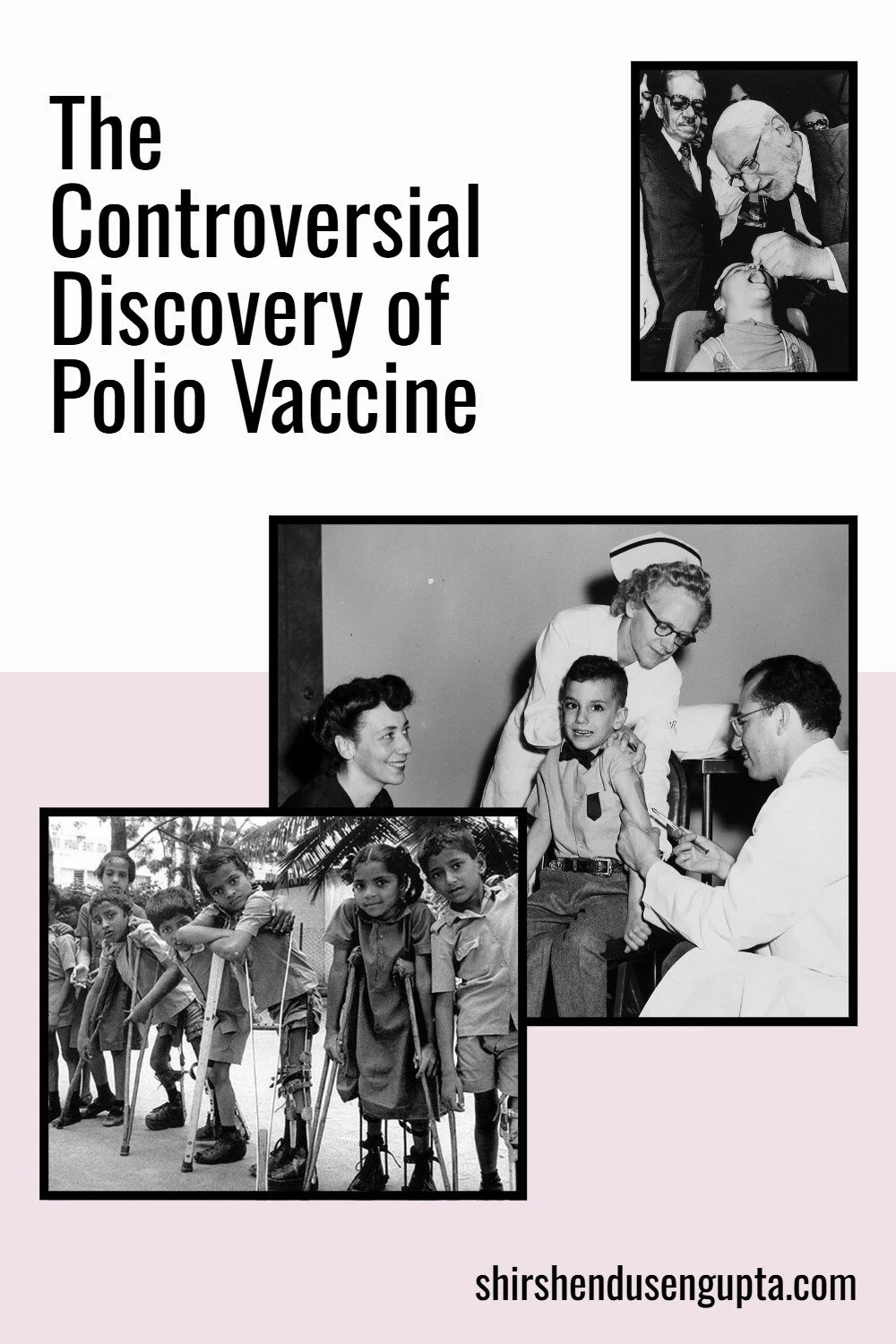
Dr. Jonas Salk vaccinates his son, Darrell, with the polio vaccine in 1954
The Cutter Incident
Shortly after the release of Salk’s vaccine in 1955, a tragic manufacturing error occurred at Cutter Laboratories in the United States. Some vaccine batches accidentally contained live poliovirus instead of a fully inactivated virus. More than 200 children developed paralytic polio, and several died. The “Cutter Incident” became one of the most important events in vaccine safety history and led to far stricter regulations for vaccine production worldwide.
The polio ward in 1955 at Haynes Memorial Hospital in Boston, where iron lung respirators helped patients breathe following the Cutter incident
Development of the Oral Vaccine (OPV) by Albert Sabin
Albert Sabin developed the oral polio vaccine, called OPV, in 1957. Unlike Salk’s vaccine, Sabin used a live attenuated virus, meaning the virus was weakened but still alive. Sabin weakened the virus by repeatedly culturing it in non-human cells at temperatures lower than normal body temperature. During this process, spontaneous mutations reduced the virus’s neurovirulence, making it much less dangerous. The oral vaccine became available in the early 1960s and quickly became popular worldwide because it was inexpensive, easy to administer, and highly effective during mass vaccination campaigns.
The Sabin vaccine is given orally, usually as drops placed directly into the mouth.
Efficacy of OPV
The oral vaccine provides approximately 95 percent protection.
Side Effects of OPV
In extremely rare cases, OPV can cause vaccine-associated paralytic polio because it contains a weakened live virus.
Albert Sabin administering oral polio vaccine to a child
Who Won the Nobel Prize for Polio and Why Salk or Sabin Didn’t?
Jonas Salk and Albert Sabin never won the Nobel Prize primarily due to scientific politics, professional jealousy, and the Nobel Committee's preference for honoring the foundational discovery of cultivating the virus rather than the subsequent creation of the vaccines.
The 1954 Nobel Precedent
In 1954, the Nobel Prize in Physiology or Medicine was awarded jointly to:
John Enders
Thomas H. Weller
Frederick Chapman Robbins
The Nobel Committee honored them for discovering that poliovirus could be grown in tissue cultures outside nervous tissue. This breakthrough was revolutionary because scientists previously believed poliovirus could only grow in nervous tissue. Their tissue culture method allowed large-scale production of poliovirus in laboratories, which made vaccine development possible.
The Nobel Committee considered this discovery to be the true scientific breakthrough behind the development of the polio vaccine. Because the Nobel Committee traditionally awards prizes for the initial discovery rather than practical applications or products, this decision set a precedent that made it exceedingly difficult for Salk or Sabin to receive subsequent recognition for their vaccines.
Fierce Rivalry and "Kitchen Chemistry"
The scientific community was deeply divided over which approach was best - the inactivated (killed-virus) Salk vaccine or the more inexpensive and easily distributable oral (live-weakened virus) Sabine vaccine. The rivalry between the two men was intense. Sabin notoriously dismissed Salk's methodology as "kitchen chemist's work," arguing that Salk's success relied entirely on the foundational science established by Enders and others. This relentless infighting and public bickering created friction with the Nobel Committee, as many scientists actively campaigned against each other rather than presenting a unified front for a shared prize, which ultimately worked against both men receiving the prize.
Salk's Strained Relationship with Academia
Despite his status as an American hero, Salk faced heavy professional jealousy. Many established academicians and the scientific elite viewed him as a "publicity hound" because of the immense public adulation he received. Salk was also accused of downplaying the contributions of his own research team and fellow scientists. This alienation contributed to his notable rejection from the prestigious National Academy of Sciences, further distancing him from Nobel consideration.
Nobel laureates Thomas Weller, Frederick Robbins, and John Enders (from left to right)
The Global Fight Against Polio
The introduction of IPV and OPV transformed global public health. Massive vaccination campaigns dramatically reduced polio cases worldwide. In 1988, the World Health Organization launched the Global Polio Eradication Initiative. At that time, polio paralyzed more than 350,000 children annually across 125 countries.
Today, most countries have successfully controlled or eliminated polio. Wild poliovirus type 1 still survives mainly in Afghanistan and Pakistan. The world now stands very close to eradicating polio completely, only the second human disease after smallpox to achieve this milestone.
Poster of Global Polio Eradication Initiative
Epilogue
Whether or not Jonas Salk and Albert Sabin received the Nobel Prize is ultimately less important than the impact of their work. Their vaccines prevented millions of children from suffering paralysis, disability, and death. Generations of parents across the world owe them an enormous debt of gratitude. Jonas Salk once famously said: “The people, I would say. There is no patent. Could you patent the sun?” Those words perfectly capture the spirit of scientific service to humanity. The history of the polio vaccine is therefore not only a story of scientific discovery, but also a story of courage, competition, sacrifice, and dedication to saving human lives.
This article is authored by my father Dr. Kamal Kumar Sengupta. He is a retired doctor with a five-decade-long career as an eye surgeon, a patented inventor of ophthalmic surgical instruments, and an author of ocular pharmacology textbooks. Post-retirement, he decided to invest his time in writing motivational stories from across the globe that will inspire future generations to experience the world, explore ideas, and follow their dreams. I hope you liked this article and if you did, don’t forget to let us know in the comments below!
All images in the article are royalty-free images from jstor.org and commons.wikimedia.org used for visualization purposes only. We hold no copyright on the images.
Pin the article
Bookmark the article for reading later!
Want us to write an article for you?
Articles for magazines, newspapers, and websites!
Watch our Videos
Check out our videos on our Youtube Channel!
Join the Newsletter
Get updates on our latest articles!
We respect your privacy. Read our policy here.




The history of modern medicine contains many remarkable discoveries, but few stories are as fascinating as that of Sir Ronald Ross, the Indian-born British doctor whose research transformed humanity’s understanding of malaria. Working under difficult conditions in British India during the late nineteenth century, Ross carried out the experiments that proved mosquitoes transmit the deadly malaria parasite, a discovery that eventually earned him the Nobel Prize in Medicine in 1902.