
The Story of Sir Ronald Ross: the Indian-Born British Doctor Who Won the Nobel Prize
Prologue
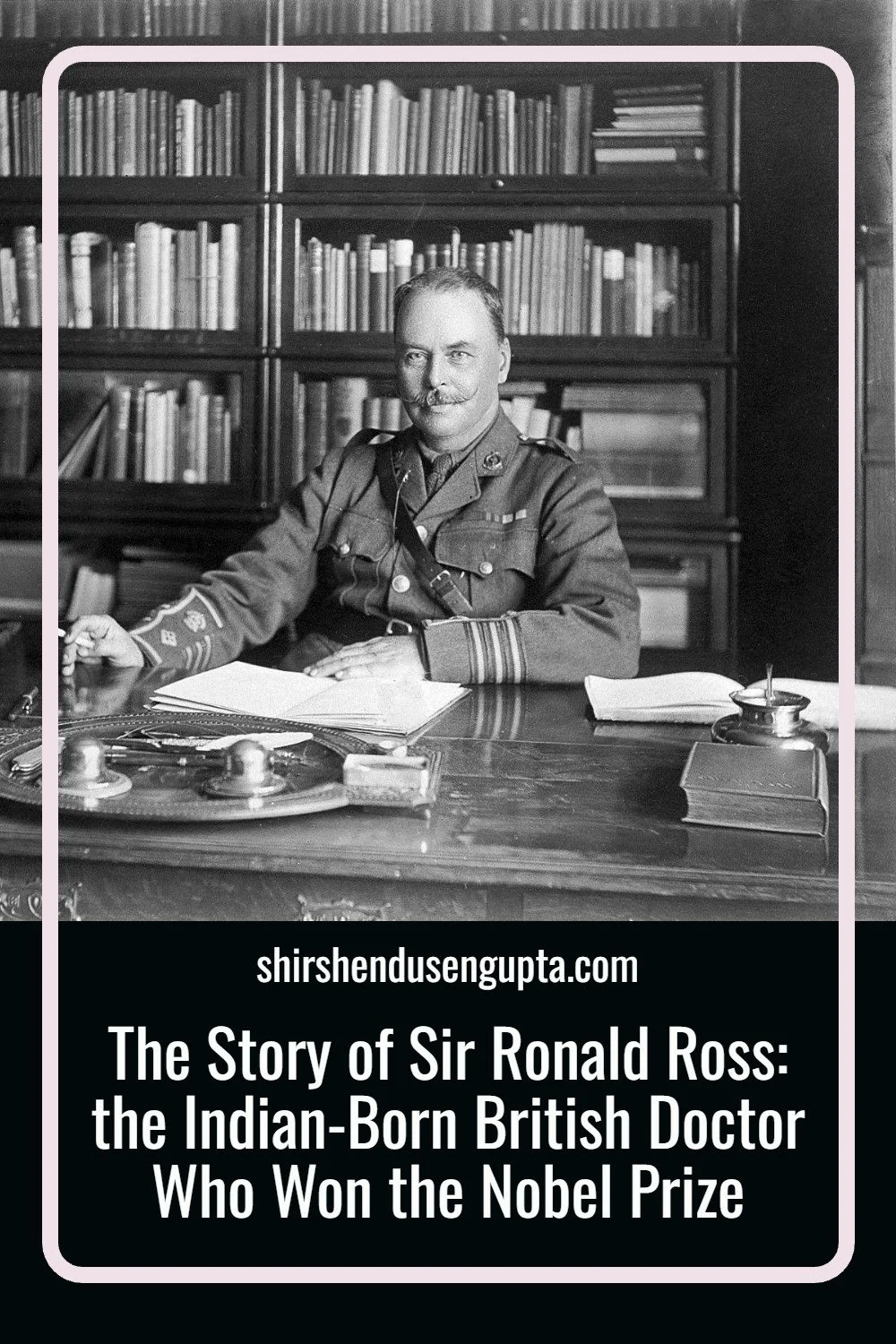
The history of modern medicine contains many remarkable discoveries, but few stories are as fascinating as that of Sir Ronald Ross, the Indian-born British doctor whose research transformed humanity’s understanding of malaria. Working under difficult conditions in British India during the late nineteenth century, Ross carried out the experiments that proved mosquitoes transmit the deadly malaria parasite, a discovery that eventually earned him the Nobel Prize in Medicine in 1902.
What makes this achievement especially significant for India is that much of his groundbreaking research was conducted in places such as Secunderabad, Bangalore, and Calcutta. The laboratories, hospitals, and military stations of colonial India became the setting for one of the greatest medical breakthroughs in history.
Sir Ronald Ross was far more than a physician. He was also a mathematician, writer, poet, and researcher whose work changed tropical medicine forever. His discovery not only saved millions of lives across the world but also laid the foundation for modern malaria prevention programs. Even today, more than a century later, the name of Sir Ronald Ross remains deeply connected with India, where his historic scientific journey reached its greatest success.
The Historic Laboratory in Calcutta
When Ronald Ross was posted in Calcutta, he worked at the famous Presidency General Hospital, later known as PG Hospital. Today, the institution is known as SSKM Hospital and the Institute of Post Graduate Medical Education and Research (IPGMER). Ross was given a laboratory room located outside the main hospital premises. In this modest setting, he quietly and patiently conducted some of the most important malaria research in human history.
Over time, the old structure disappeared, and a large multistoried medical building replaced it. Interestingly, the author of this article had the opportunity to work in this very building as a teacher of Pharmacology during 1975–1976. Thus, the place still carries a deep emotional and historical connection.
Ronald Ross Laboratory in Kolkata (formerly Calcutta) today
Early Life of Ronald Ross
Sir Ronald Ross was born on 13 May 1857 in Almora, then part of British India, in the Himalayan region of present-day Uttarakhand. Some historical writings of earlier generations mistakenly linked Almora with Nepal because of old territorial associations in the Himalayan belt. Ronald was the first of ten children. His father, General Sir Campbell Claye Grant Ross, was a senior British officer serving in India. Ross spent his early childhood in India before being sent to England at the age of eight for education. He stayed with his uncle and aunt on the Isle of Wight and attended school at Ryde. Later, in 1869, he joined a boarding school at Springhill near Southampton for secondary education. During these years, he developed strong interests not only in science but also in mathematics, literature, poetry, music, and art.
At the age of fourteen, he won a prize in mathematics and received a book titled ‘Orbs of Heaven.’ The book deeply inspired him and strengthened his love for mathematics and scientific thinking. In 1873, at only sixteen years of age, he secured first place in the Oxford and Cambridge local examination in drawing. Interestingly, Ronald Ross originally wanted to become a writer rather than a doctor. However, his father encouraged him toward medicine and admitted him to St Bartholomew's Hospital Medical College in London in 1874. He qualified as a Member of the Royal College of Surgeons and later became FRCS in 1879.
Entry into Medical Service
After medical training, Ross briefly worked as a ship’s surgeon on a steamship. Simultaneously, he studied for the Licentiate examination of the Society of Apothecaries. After succeeding in 1881, he underwent four months of training at the Army Medical School. On 5 April 1881, Ronald Ross officially joined the Indian Medical Service under the Madras Presidency as a surgeon. He later obtained a Diploma in Public Health from the Royal Colleges of Physicians and Surgeons. During this period, he also trained in bacteriology under Professor E. E. Klein, one of the leading bacteriologists of the time.
Return to India and Early Observations
Ross sailed for India on 22 September 1881 aboard a troopship. Between 1881 and 1894, he served in many places across British India, including Madras, Bangalore, Secunderabad, Baluchistan, the Andaman Islands, and Moulmein in Burma, now Myanmar. While stationed in Bangalore, Ross noticed something important. Areas with stagnant water had enormous mosquito populations, while cleaner areas had fewer mosquitoes. This observation later became central to malaria prevention strategies throughout the world.
However, this wasn’t a completely unknown fact. The name malaria itself comes from medieval Italian “mala aria,” which literally translates to “bad air.” For centuries, people, dating back to the Ancient Romans, noticed that the fever-inducing disease was most common in swampy, marshy areas. Before the discovery of microscopic germs, scientists believed the illness was caused by breathing in the foul, damp vapors (or "miasmas") rising from these stagnant waters. Ross’s observation confirmed the same.
Meeting the Mentor Who Changed History
In 1894, while on leave in London, Ross met Sir Patrick Manson, the famous physician later known as the “Father of Tropical Medicine.” Manson strongly believed mosquitoes played a role in spreading malaria and encouraged Ross to investigate the theory scientifically. He advised Ross that India was the ideal place for malaria research because of the large number of patients and tropical conditions. This meeting completely transformed Ross’s career.
Sir Patrick Manson
The Search for the Malaria Parasite
Ross returned to Secunderabad in April 1895 with renewed determination. Soon afterward, he was transferred to Bombay Civil Hospital, where he began examining malaria patients and dissecting mosquitoes. During these studies, he observed pigmented cells inside mosquitoes, which were later recognized as stages of the malaria parasite.
In May 1895, he made a major breakthrough when he detected early developmental stages of the malaria parasite inside the stomach wall of an Anopheles mosquito. Unfortunately, before he could continue his work, he was transferred again, this time to Bangalore during a cholera outbreak. Frustrated but determined, Ross continued his investigations. During a visit to Sigur Ghat near Ooty in the Nilgiri Hills, he noticed a mosquito sitting at a peculiar angle on a wall. This insect was later identified as an Anopheles mosquito, the very species responsible for malaria transmission. Ironically, while searching for the cause of malaria, Ross himself contracted malaria in 1896 despite taking preventive quinine.
An Anopheles mosquito rests at a distinctive angle of 45 to 90 degrees unlike common mosquitoes (such as Culex or Aedes)
The Historic Discovery of 1897
After years of struggle and repeated transfers, Ronald Ross finally achieved the discovery that changed medical science forever. In July 1897, he raised twenty brown mosquitoes from collected larvae and allowed them to feed on the blood of malaria patients. A few days later, he dissected the mosquitoes and found malaria parasites developing inside their guts. The next day, he repeated the experiment and confirmed the findings.
This historic discovery proved that mosquitoes carried malaria parasites and transmitted the disease. Ross recorded the date of the discovery as 20 August 1897. Today, this date is celebrated globally as World Mosquito Day. His findings were published in the Indian Medical Gazette on 27 August 1897 and later in the British Medical Journal in December of the same year.
Malaria parasites in a mosquito midgut
Calcutta Research and Bird Malaria
Soon after publication of his findings, Ross was transferred again to places with fewer malaria cases. Eventually, he arrived in Calcutta in February 1898 and joined the Presidency General Hospital. There, he was allowed to use the laboratory of Surgeon Lieutenant General Cunningham.
For nearly two years, Ross struggled without major progress. He then contacted Patrick Manson again, who suggested using bird malaria instead of human malaria for experiments. Ross followed the advice and focused on avian malaria. In 1898 and 1899, he demonstrated that Culex mosquitoes transmitted bird malaria and that parasites traveled to the mosquito’s salivary glands before infecting another host. This completed the scientific explanation of malaria transmission.
Lesions in an ‘i‘iwi (Drepanis coccinea) with acute malaria. Note enlarged, blackened liver.
Return to England and International Fame
After completing his groundbreaking work, Ross resigned from the Indian Medical Service and returned to England. He joined the Liverpool School of Tropical Medicine as a lecturer and continued malaria research in various parts of the world, including West Africa, Greece, and the Suez Canal region. In 1902, he became Professor and Chair of Tropical Medicine at Liverpool. The same year, he received the Nobel Prize in Physiology or Medicine for discovering the transmission mechanism of malaria parasites.
Sir Ronald Ross, C.S. Sherrington, and R.W. Boyce in a laboratory at the Liverpool School of Tropical Medicine. Gouache by W.T. Maud, 1899.
The Nobel Prize Controversy
The Nobel Prize was not without controversy. Italian scientist Giovanni Battista Grassi and his colleagues had also conducted important research on human malaria transmission. Initially, the Nobel Committee considered sharing the prize between Ross and Grassi. However, Ross strongly accused Grassi of using his findings unfairly. Several influential scientists, including Robert Koch, supported Ross. Ultimately, the Nobel Committee awarded the prize solely to Ronald Ross.
To know more about Robert Koch and his contributions to mankind, please read our article The Story of Koch and Waksman - Two Superstars Who Saved Mankind from the Menace of Tuberculosis.
Giovanni Battista Grassi
Honors and Recognition
Ross received numerous honors during his lifetime:
Cameron Prize for Therapeutics from Edinburgh University in 1901
Fellow of the Royal Society (FRS) in 1901
Nobel Prize in Medicine in 1902
Knighthood in 1902
Knight Commander of the Bath (KCB)
Knight Commander of St Michael and St George (KCMG)
Albert Medal in 1923
Manson Medal in 1929
Later Career and Writings
In 1912, Ross became Physician for Tropical Diseases at King’s College Hospital in London while simultaneously holding the Chair of Tropical Sanitation in Liverpool. During the First World War, he served as Honorary Consultant in Malariology to the British War Office. He also wrote an influential book titled ‘The Prevention of Malaria’ in 1910, which became one of the foundational texts in tropical medicine and public health. In 1926, the Ross Institute and Hospital of Tropical Diseases was established in London, and Ross served as its Director-in-Chief until his death. Later, the institute became part of the London School of Hygiene & Tropical Medicine.
The Ross Institute & Hospital for Tropical Diseases, Putney Heath, London
Personal Life
Ronald Ross married Rosa Bessie Bloxam in 1889. The couple had two sons and two daughters. Mrs. Ross passed away in 1931. Sir Ronald Ross died on 16 September 1932 at the Ross Institute in London at the age of seventy-five. He was buried at Putney Vale Cemetery beside his wife.
Ronald Ross: More Than a Doctor or a Scientist
Sir Ronald Ross was not only a doctor and scientist, but he was also a mathematician, poet, novelist, musician, and writer. He maintained friendships with many celebrated personalities of his era, including:
Sir Patrick Manson
Alphonse Laveran
Arthur Conan Doyle
Rudyard Kipling
H. G. Wells
H. Rider Haggard
King Edward VII himself honored Ross with knighthood.
Epilogue: Why India Still Remembers Ronald Ross
Although Ronald Ross was British, India remains deeply connected to his scientific triumph. It was in India that he carried out the experiments that transformed humanity’s understanding of malaria. From the hospitals of Calcutta to the military stations of Secunderabad and Bangalore, India served as the laboratory for one of the greatest medical discoveries in history. Millions of people across tropical countries continue to benefit from his work even today. For this reason, Indians also proudly remember Sir Ronald Ross as one of the great medical pioneers whose discoveries emerged from the soil of India itself.
This article is authored by my father Dr. Kamal Kumar Sengupta. He is a retired doctor with a five-decade-long career as an eye surgeon, a patented inventor of ophthalmic surgical instruments, and an author of ocular pharmacology textbooks. Post-retirement, he decided to invest his time in writing motivational stories from across the globe that will inspire future generations to experience the world, explore ideas, and follow their dreams. I hope you liked this article and if you did, don’t forget to let us know in the comments below!
All images in the article are royalty-free images from jstor.org and commons.wikimedia.org used for visualization purposes only. We hold no copyright on the images.
Pin the article
Bookmark the article for reading later!
Want us to write an article for you?
Articles for magazines, newspapers, and websites!
Watch our Videos
Check out our videos on our Youtube Channel!
Join the Newsletter
Get updates on our latest articles!
We respect your privacy. Read our policy here.




The history of modern medicine contains many remarkable discoveries, but few stories are as fascinating as that of Sir Ronald Ross, the Indian-born British doctor whose research transformed humanity’s understanding of malaria. Working under difficult conditions in British India during the late nineteenth century, Ross carried out the experiments that proved mosquitoes transmit the deadly malaria parasite, a discovery that eventually earned him the Nobel Prize in Medicine in 1902.