Morocco Travel
Morocco, a land of color and contrasts, stretches from the golden dunes of the Sahara to the breezy blue coasts of the Atlantic and Mediterranean. It is a country where Berber, Arab, and European cultures intertwine in a vibrant mosaic of tradition and transformation. Morocco’s history spans thousands of years - home to the Carthaginians, Romans, and Islamic dynasties, each of whom left indelible marks on its cities, art, and architecture.
But Morocco is more than its past. It’s alive in the rhythm of everyday life - the call to prayer echoing through mountain valleys, the scent of spices drifting through maze-like markets, the ornate tiles that line ancient courtyards, and the timeless landscapes that shift from sea cliffs to sand dunes. Each region tells a different story, yet all are bound together by the country’s deep spirit of hospitality and beauty.
Through this series of articles, I intend to share our stories and experiences of traveling across Morocco with our fellow photography and travel enthusiasts. I hope they help you plan your travels across this beautiful country!
Nestled between the Rif Mountains and the Mediterranean coast, the UNESCO World Heritage town of Tetouan carries an identity shaped by its location, history, and cultural soul. Known as La Blanca or The White Dove, the city gleams with whitewashed buildings that reflect purity, elegance, and a deep connection to its Andalusian past. Tetouan flourished in the fifteenth and sixteenth centuries when Muslim and Jewish refugees crossed from Spain, bringing with them a legacy of art, architecture, language, and craftsmanship that continues to define the city’s atmosphere. Their influence is visible in the medina’s delicate wooden balconies, tiled courtyards, and intricate carvings that mirror the traditions of Andalusia.
Tucked along Morocco’s Atlantic coast, Asilah is a town where history, art, and the sea meet in poetic harmony. Its whitewashed walls, accented by bright blue doors and colorful murals, make it one of the most photogenic towns in the country. Originally settled by the Phoenicians as early as 1500 BCE, Asilah has seen a parade of rulers - Romans, Idrisids, Portuguese, and Spaniards - each leaving behind a unique architectural and cultural footprint. The Portuguese built the city’s ramparts in the 15th century, parts of which still encircle the medina today. In the 20th century, Moroccan authorities restored the medina, making it one of the cleanest and best-preserved in the country.
During the tenth labor of Hercules, which was to retrieve the cattle of Geryon, a fearsome giant, he had to pass through the Atlas Mountains, then thought to be the edge of the known world. Legend has it that instead of scaling the mighty mountain range, Hercules smashed through it with his superhuman strength, creating the Strait of Gibraltar and separating Europe from Africa. The Caves of Hercules are said to be the place where he rested after this heroic act before moving on towards his eleventh labor, i.e., stealing the Apples of the Hesperides.
Chefchaouen, dubbed as the ‘Blue City of Morocco,’ is a picturesque town nestled in the Rif Mountains of northern Morocco. It is a haven for photographers, artists, and seekers of serenity. What truly sets it apart is its iconic blue palette. Painted in calming shades of sky, azure, and indigo, the town’s medina is a maze of narrow alleyways, staircases, and doorways drenched in layers of blue. With a slow pace, friendly locals, artisanal handicrafts, and unmatched scenery, Chefchaouen is more than a destination - it’s an experience carved in cobalt and tranquility.
Northern Morocco is where Africa meets Europe, where the Mediterranean kisses the Atlantic, and where history, culture, and landscape collide in vibrant harmony. This region is known for its rich cultural tapestry, rooted in centuries of Berber, Arab, Andalusian, and European influence. From Phoenician traders to Roman conquerors, Islamic dynasties to Spanish and French colonial powers, each era has left behind its imprint in the architecture, art, and spirit of the north.
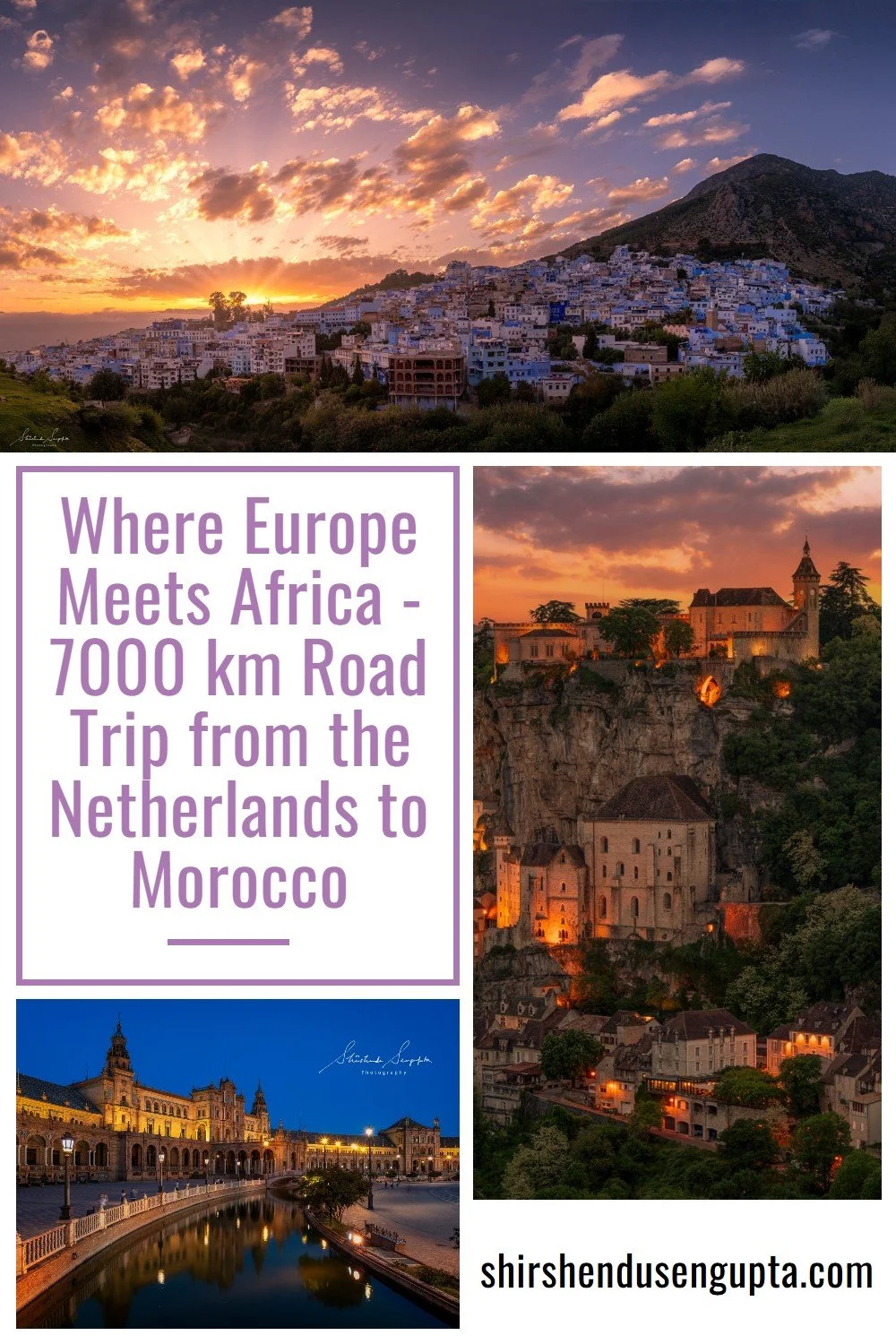
There’s something magical about crossing continents by car, witnessing Europe gradually give way to Africa, with every turn of the wheel revealing a new landscape, language, culture, or cuisine. Our epic 7000 km adventure began from the Netherlands and first took us south to the rolling vineyards of Saint-Émilion and Bordeaux in France. From there, we drove deep into Spain, soaking in the sun-kissed charm of Seville before crossing into Morocco to explore the blue alleys of Chefchaouen, the artistic vibes of Asilah, the coastal cityscapes of Tangier and Tétouan, and the tranquil seaside towns of M’diq and Martil. On our journey back, we passed through Gibraltar, where Europe and Africa almost touch, then re-entered France for a spiritual pause in Lourdes and Rocamadour before heading back home to the Netherlands.
Tangier, perched at the meeting point of Europe and Africa, has always been a city that sparks curiosity and imagination. With Spain visible across the Strait of Gibraltar, the city has for centuries served as a natural bridge between continents. Phoenicians, Romans, Arabs, Portuguese, and Spanish all shaped its character, leaving traces of their civilizations in the streets, squares, and fortifications that still define the urban landscape. Its strategic location allowed Tangier to become a bustling port city where merchants, travelers, and diplomats gathered, creating a multicultural identity that continues to thrive today.